INTRODUCTION
Buffaloes play a prominent role in rural livestock production, particularly in Asia, and factors affecting productivity are of paramount importance to agricultural economics in this region of the world. Reproductive efficiency is the primary factor affecting productivity and is hampered in female buffalo by inherent late maturity, poor estrus expression in summer, distinct seasonal reproductive patterns, and prolonged intercalving intervals (Singh et al., 2000).
During the last two decades, considerable attention has been focused on reproductive physiology and endocrinology, with the aim of developing models to improve reproductive efficiency, particularly using controlled breeding techniques in buffaloes (Barile, 2005). Estrus synchronization protocols, largely derived from cattle, have yielded variable results in buffalo (De Rensis and Lo’pez-Gaitus, 2007). For the successful application of a synchronization protocol, clear knowledge of the hormonal regulation of the estrous cycle and follicular dynamics is required.
Generally estrus synchronization is achieved by two approaches. The first approach is by controlling the luteal phase of the cycle either through the administration of prostaglandins (Brito et al., 2002) or use of progesterone analogues (De Rensis et al., 2005). These regimens indicate that estrus response varies from 80-95% (Chohan, 1998, Barile et al, 2001) and fertility ranges from 20 to 50% (Barile et al., 1997, Chohan, 1998). The limitation of prostaglandins became obvious as it would work only if a corpus luteum is present (Chohan, 1998, Brito et al., 2002); and the responses were usually varied at different stages of the estrous cycle (De Rensis and Lo’pez-Gaitus, 2007). The disadvantage to the use of progestins is that fertility is reduced (Beal et al., 1998) due to extension of the life span of dominant follicles (persistent follicle) and ovulation of sub fertile oocytes in cows (Ahmad et al., 1995). The CIDR device was developed by Macmillan et al., 1991 and it is well adopted in synchronizing estrus consistently that (has) resulted in high pregnancy rates in cattle, regardless of stage of the estrous cycle. Because of the short treatment period (7 d), the incidence of persistent follicles is reduced.
The second and more recent approach of synchronization is by controlling the follicular development and ovulation using combinations of prostaglandins (Twagiramungu et al., 1995), progesterone (Macmillan et al., 1991, Neglia et al., 2003), GnRH (Berber et al., 2002) and hCG (Companile et al., 2007). Of these, OVSYNCH (GnRH- PGF2α-GnRH) protocol became the most popular. However, its major demerits are that its ineffectiveness in non cyclic animals, questionable ovulation of follicle in response to 1st GnRH, ovulation of too small follicles with inadequate LH receptors and about 10% of cows show estrus between first GnRH and PGF2α. It has been suggested, therefore, that these protocols could be more useful when associated with treatments of short and long term progestagens (Barile, 2005). Perhaps it was for this reason that newer concept of synchronous wave emergence, follicular development and ovulation was developed in cows (Bo et al., 1996). This approach was further facilitated by combining the use of CIDR device (Martinez et al 1997) with GnRH or EB for successful wave emergence with optimal fertility.
In buffalo, limited work has been done on synchronization of estrus with CIDR (Singh, 2005, Murugavel et al., 2009) and practically no information available on synchronization of follicular wave emergence. Therefore, the present study was designed to evaluate the effect of GnRH and estradiol benzoate on follicular wave emergence, estrus, ovulation and pregnancy rate in CIDR treated Nili-Ravi buffaloes.
MATERIALS AND METHODS
Animals and treatment: This study was conducted during breeding season (November-December 2007) at Buffalo Research Institute Pattoki, District Kasur Pakistan. Lactating buffaloes were maintained in free-stall facilities, fed optimal ration, and milked twice daily. Twenty five non-cyclic lactating buffaloes of moderate body condition and body weight, were included in this experiment, ranging from 2 to 4 lactations and >90 days postpartum. Buffaloes were examined through ultrasonography (ultrasound) before and at the start of the experiment. All buffaloes received a controlled internal drug release device containing 1.38 g of progesterone (CIDR® Progesterone; EazibreedTM; New Zealand). At the time of CIDR insertion, buffaloes in the GnRH group (n = 6) received (100 μg; Dalmarelin; Fatro®, Italy; 2 ml, i.m.) and those in the EB group (n = 9) received estradiol benzoate (3 mg plus 50 mg progesterone; Duoton Fort®; T.P Drug, Lab., Thailand; 2 ml; i.m.). Buffaloes in the control group (n = 10) received no further treatment. Thereafter, all buffaloes received the PGF2α (0.150 mg; Dalmazine, Fatro®, Italy; 2 ml; i.m.) on day 6 and CIDR’s were removed on day 7 (Fig. 1).
Estrus detection and AI: Estrus detection was carried twice daily using penile deviated teaser bull. Because of low intensity of estrus behavior in buffaloes, they were confirmed for presence of tone in uterus, vaginal mucus, vulvular swelling and a large follicle >9 mm using ultrasonography. Buffaloes detected in estrous (n = 22) were once inseminated using frozen thawed semen from single bull (Semen Production Unit, Qadirabad) of known fertility approximately 12 h after the standing oestrus.
Ultrasound scanning and Pregnancy diagnosis: The ovaries of each buffalo were examined by transrectal ultrasonography (Honda; Model: HS-1500; 7.0 MHz) daily from day of CIDR insertion to ovulation. All visible follicles (>4 mm in antral diameter) were measured and mapped individually for each buffalo. The dominant follicle of a wave was defined as the follicle reaching the largest diameter. The emergence of a follicular wave was identified on the day that the dominant follicle was retrospectively identified to have a diameter of 4–5 mm along with cohort of follicles. Ovulation was defined when the previously identified follicle (>9 mm) disappeared on subsequent ultrasound scan. Pregnancy diagnosis was determined at 45 days after insemination, using ultrasonography. This was based on the presence of fetal heart beat and amniotic fluid.
Statistical analysis: All data were analyzed with a statistical software program (SPSS Version 10.0 for Windows; SAS Institute, Cary, North Carolina, USA). Data are presented as mean ± S.E.M. The wave emergence, interval to estrus, interval to ovulation and size of the ovulatory follicle among the groups were compared using ANOVA. Pregnancy rates and estrus response among treatment groups were compared by chi-square analysis. A probability level of (P < 0.05) was considered significant.
RESULTS
Effect of GnRH and EB on estrus response, follicular wave emergence, ovulation and pregnancy rate in CIDR treated buffaloes has been presented in Table 1. Although the follicular wave emergence did not differ due to treatment (P > 0.05), it was earlier in buffaloes given GnRH and EB than control. Similarly, the estrus response did not differ (P > 0.05) among the groups but it was lowest in EB buffaloes. The mean interval to estrus from PGF2α (64 ± 12.3 h) did not vary due to treatment but was delayed in buffaloes given GnRH. The mean interval to ovulation after estrus (38.6 ± 7.9 h) did not change because of treatment. There was no significant difference in mean size (9.9 ± 0.5 mm) of the ovulatory follicle among the groups. Likewise, pregnancy rate (6/19, 30 %) remained the same across the treatments.
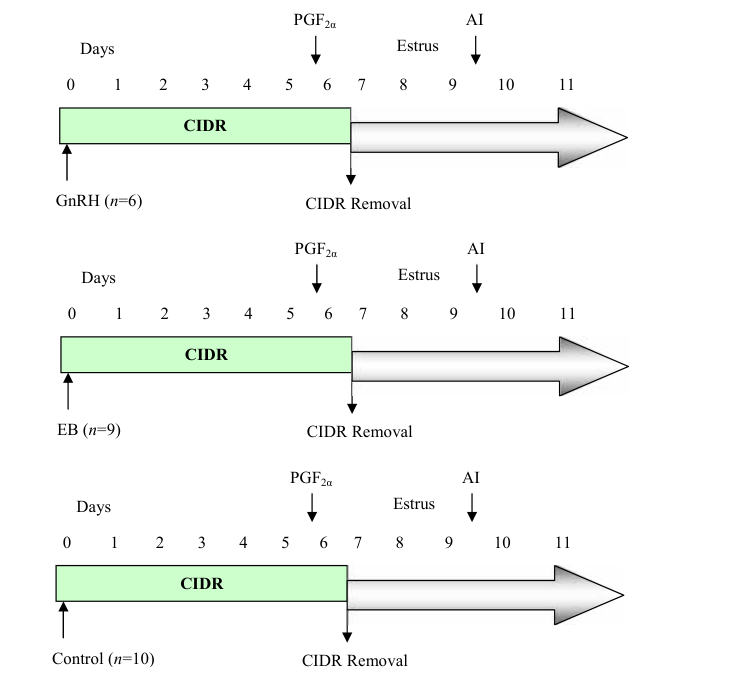
Fig. 1: Time line for three treatment groups; GnRH, EB (estradiol benzoate + progesterone) and control in CIDR treated buffaloes
Table 1: Effect of GnRH and EB on estrus response, follicular wave emergence, ovulation and pregnancy rate in CIDR treated buffaloes | Variable | GnRH (n = 6) | EB n = 9) | Control (n = 10) | P-value |
|---|
| Wave emergence (days) | 2.3 ± 0.3 | 3.3 ± 0.3 | 4 ± 0.5 | 0.90 |
| Estrus response (%) | (5/6) 80 | (6/9) 66 | (8/10) 80 | 0.70 |
| Interval to estrus from PGF2α (h) | 80.0 ± 21.1 | 56 ± 8.0 | 56 ± 8.0 | 0.35 |
| Interval to ovulation after estrus (h) | 44 ± 4 | 36 ± 6.9 | 36 ± 12.9 | 0.55 |
| Ovulatory follicle size (mm) | 10.5 ± 0.7 | 9.8 ± 0.1 | 9.6 ± 0.1 | 0.65 |
| Pregnancy rate (%) | (1/5) 20 | (2/6) 33 | (3/8) 38 | 0.82 |
Values are mean ± S.E.M.
None of the differences among groups were statistically significant (P > 0.05)
GnRH: buffaloes received GnRH at time of CIDR insertion. EB: buffaloes received 2mg EB plus 50 mg P4 at the time of CIDR insertion. Control: buffaloes received CIDR only.
DISCUSSION
The present study demonstrates, for the first time, that the GnRH or EB treatments are equally effective to synchronize the follicular wave emergence, resulting in spontaneous ovulation when used in combination with CIDR in buffaloes. Similarly, Martinez et al., 1997 showed that GnRH and EB can induce wave emergence in CIDR treated beef cows. The timing of emergence of wave was significantly earlier in GnRH, and ablated cows than EB or controls in their study. In another report administration of GnRH resulted in significantly earlier wave emergence (2.3 days) than EB (4.4 days) in CIDR treated in repeat breeder Holstein cows (Kim et al., 2007). The variation in results in our and these studies could be due to differences in species, lactation, physiological state of animals, experimental conditions and number of animals. The hormonal mechanism of wave emergence indicates that it could be either due to the direct effect of GnRH or an indirect consequence of EB. Administration of GnRH induces the release of FSH and LH from the pituitary and alters the pattern of growth of the existing follicle wave, causing ovulation and inducing a new wave emergence 1–2 days later (Diskin et al., 2002). On the other hand administration of EB resulted in atresia of dominant follicle followed by a new follicular wave after an interval of about 4 days from treatment (Bo et al., 1995).The rationale of CIDR treatment was to provide a uniform and controlled luteal phase (Macmillan et al., 1991). The temporal associations of progesterone and estradiol and gonadotropins (FSH and LH) in this model need to be investigated in buffaloes. These observations imply that GnRH and EB can synchronize follicular wave emergence effectively in CIDR treated buffaloes in the same way as in cows.
The proportion of buffaloes responding to the treatment and exhibiting estrus in the present study was 75 percent. This is in agreement with the earlier work in cows in which the response varied from 55-100% (Martinez et al., 1997, Martinez et al., 2000). The interval from administration of PGF2α to estrus averaged 64 hrs in our study. Whereas this interval was 48 hrs with EB and 63 hrs with GnRH when these treatments were given at time of insertion as well as removal of CIDR in beef cows (Martinez et al., 2000). This means that GnRH and EB can synchronize estrus effectively in CIDR treated buffaloes in the same way as in cows.
Ovulation occurs under the influence of hormonal cascade and its timing has significant affect on fertility. In the present study, ovulation took place spontaneously about 38 hrs after the onset of standing estrus. This duration is consistent with the previous studies in buffaloes (Warriach et al., 2008). Synchronization protocols using timed AI are usually accompanied by induced ovulation in cattle (Martinez et al., 2000). In the current study, with once AI at detected estrus the pregnancy rate was 30%. This is lower than earlier work reported in beef (75%) (Martinez et al., 1997, Martinez et al., 2000) and Holstein cow (50%) where more or less similar protocol was used (Kim et al., 2007). Typically, the fertility rate in buffaloes inseminated with frozen semen is generally reported to be lower than in cows (Andarbi et al., 2001). In conclusion, this preliminary data indicate that administration of GnRH and EB result in emergence of follicular wave, estrus and ovulation and similar pregnancy rate in CIDR treated buffaloes. Future studies are indicated to determine the affect of induced ovulation with timed AI in a similar model.
Acknowledgements: The authors wish to thank Dr. Muhammad Mushtaq from Buffalo Research Institute for providing facilities; ALP PARC, Islamabad for funding the project and Shahzad Ahmad and Amanullah Shah for assistance during the study.
REFERENCES
Ahmad, N., F. N. Schrick, R. L. Butcher and E. K. Inskeep (1995). Effect of persistent follicles on early embryonic losses in beef cows. Biol. Reprod. 52:1129–1135.
Andrabi, S. M. H., N. Ahmad, A. Abass and M. Anzar. (2001). Effect of two different antibiotic combinations on fertility of frozen buffalo and Sahiwal bull semen. Pakistan Vet. J. 23:106-113.
Barile, V. L. (2005). Review article. Improving reproductive efficiency in female buffaloes. Livest. Prod. Sci. 92:183–194.
Barile, V. L., A. Galasso, E. Marchiori and A. Borghese. (1997). Effect of PRID treatment on oestrus synchronization and progesterone levels in Italian buffaloes. Proc. V World Buffalo Congress, Caserta, Italy. pp.738–743.
Barile, V. L., A. Galasso, E. Marchiori, C. Pacelli, N. Montemurro and A. Borghese (2001). Effect of PRID treatment on conception rate in Mediterranean buffalo heifers. Livest. Prod. Sci. 68:283– 287.
Beal, W. E., J. R. Chenault, M. L. Day and L. R. Corah. (1988). Variation in conception rates following synchronization of estrus with melengestrol acetate and prostaglandin F2α. J. Anim. Sci. 66:599–602.
Berber, C. De A. R., E. H. Madureira and P. S. Baraselli. (2002). Comparison of two ovsynch protocols (GnRH vs. LH) for fixed time insemination in buffalo (bubalus bubalis). Theriog. 57:1421-1430.
Bo, G. A., G. P. Adams, R. A. Pierson and R. J. Mapletoft. (1995). Exogenous control of follicular wave emergence in cattle. Therio. 43:31–40.
Bo, G. A., M. Caccia, M. F. Martinez and R. J. Mapletoft. (1996). Follicle wave emergence after treatment with estradiol benzoate and CIDR-B vaginal device in beef cattle. Proc. Int. Cong. Anim. Reprod. 7: 22.
Brito, L. F. C., R. Satrapa, E. P. Marson and J. P. Kastelic (2002). Efficacy of PGF2α to synchronize estrus in water buffalo cows (Bubalus bubalis) is dependent upon plasma progesterone concentration, corpus luteum size and ovarian follicular status before treatment. Anim. Reprod. Sci. 73:23–35
Campanile G., R. Di Palo, G. Neglia, D. Vecchio, B. Gasparrini, A. Prandi, G. Galiero and M. J. D’occhio (2007). Corpus luteum function and embryonic mortality in buffaloes treated with a GnRH agonist, hCG and progesterone. Therio. 67:1393–1398.
Chohan, K. R. (1998). Estrus synchronization with lower dose of PGF2α and subsequent fertility in subestrus buffaloes. Therio. 50:1101-1108.
De Rensis, F. and F. Lo´Pez-Gatius (2007). Protocols for synchronizing estrus and ovulation in buffalo (Bubalus bubalis): A review. Therio. 67:209– 216.
De Rensis, F., G. Ronci, P. Guarneri, B. X. Nguyen, G. A. Presicce, G. Huszenicza and R. J. Scaramuzzi (2005). Conception rate after fixed time insemination following ovsynch protocol with and without progesterone supplementation in cyclic and non-cyclic Mediterranean Italian buffaloes (Bubalus bubalis). Therio. 63:1824–1831.
Diskin, M.G., E. J. Austin and J. F. Roche (2002). Exogenous hormonal manipulation of ovarian activity in cattle. Domest. Anim. Endocrinol. 23:211–228.
Kim U. H., G. H. Suh, T. Y. Hur, S. J. Kang, H. G .Kang, S. B. Park, S. H. Kim and I. H. Kim. (2007). Comparison of two types of CIDR-based timed artificial insemination protocols for repeat breeder dairy cows. J. Reprod. and Develop. 53:639-645.
Macmillan, K. L., V. K. Taufa, D. R. Barnes and A. M. Day (1991). Plasma progesterone concentrations in heifers and cows treated with a new intravaginal device. Anim. Reprod. Sci. 21:25–40.
Martinez M.F., D.R. Bergfelt, G. P. Adams, J. P. Kastelic and R. J. Mapletoft. (1997). Synchronization of Follicular Wave Emergence and Its Use in an Estrus Synchronization Program. Therio. 47:145.
Martinez, M. F., J. P. Kastelic, G. P. Adams, E. Janzen, D. H. Mccartney and R. J. Mapletoft (2000). Estrus synchronization and pregnancy rates in beef cattle given CIDR-B, prostaglandin and estradiol, or GnRH. Can. Vet. J. 41:786-790.
Murugavel, K., D. Antoine, M. S. Raju and F. Lo´Pez-Gatius (2009). The effect of addition of equine chorionic gonadotropin to a progesterone-based estrous synchronization protocol in buffaloes (Bubalus bubalis) under tropical conditions. Therio. 71:1120–1126.
Neglia G., B. Gasparrini, R. Di Palo, C. De Rosa, L. Zicarelli and G. Campanile (2003). Comparison of pregnancy rates with two estrus synchronization protocols in Italian Mediterranean buffalo cow. Therio. 60:125-133.
Singh, C. (2003). Response of anestrus rural buffaloes (Bubalus bubalis) to intravaginal progesterone and PGF2α injection in summer. J. Vet. Sci. 4:137-141.
Singh, J., A. S. Nanda and G. P. Adams (2000). The reproductive pattern and efficiency of female buffaloes. Anim. Reprod. Sci. 60–61:593– 604.
Twagiramungu, H., L. A. Guilbault and J. J. Dufour. (1995). Synchronization of Ovarian Follicular Waves with a Gonadotropin-Releasing Hormone Agonist to Increase the Precision of Estrus in Cattle: A Review. J. Anim. Sci. 73:3141–3151.
Warriach, H. M., A. A. Channa and N. Ahmad (2008). Effect of oestrus synchronization methods on oestrus behavior, timing of ovulation and pregnancy rate during the breeding and low breeding seasons in Nili-Ravi buffaloes. Anim. Reprod. Sci. 107:62-67.