INTRODUCTION
The use of freezing as a long term preservation technique is well established for many foods and other commodities. Surprisingly, very little attention has been paid to the possibility of using freezing for the preservation of buffalo milk for rennet induced curd and cheese making. This technique can extend the shelf life of dairy products up to several months. In the last decade, there has been increasing use of buffalo, goat and ewe’s milk (in the UK) for the production of value added products like cheese, but availability of milk from these species is both seasonal and geographically restricted.
Freezing may result in undesirable changes, including textural damage, protein denaturation, and destruction of cell membranes. It is well documented that freezing of fruits, vegetables, and cheese results in textural damage related to the formation of ice crystals (Bhargava and Jelen, 1995). Freezing can also induce stresses that are capable of denaturing proteins (Franks, 1985) such as cold temperature, ice formation, solute concentration due to crystallization of water, eutectic crystallization of buffer solutes and resultant changes in pH. Studies on freezing of protein solutions (Chang et al., 1996, Jiang and Nail, 1998 & Strambini and Gabellieri, 1996) showed that fast freezing produced more damage to proteins and gave lower recovery of biological activity after freezing and thawing, the phenomenon being explained as the ice inducing partial unfolding of proteins present.
In the UK, buffalo milk is used for cheese making and for other dairy products such as pasteurized milk, butter and yoghurt. However, this is carried out on a relatively small scale and the supply of buffalo milk is limited. Hence to be able to successfully freeze the milk would be advantageous. Much research has been done on freezing with respect to milk properties (Weese et al., 1969 &1972). However, there is not sufficient data regarding the rheological properties of rennet induced curd made from frozen milk especially buffalo milk.
In the present study, the effects of freezing and thawing on the rheological properties of rennet induced curd made from frozen buffalo milk by using SAOR technique were examined. In addition to freezing and thawing, the milk buffering changes were followed by determining pH and ionic calcium levels. This study aimed at obtaining a better understanding of the mechanisms of protein denaturation during the freezing and thawing processes with the help of rheological parameters, and providing guidance for selection and optimization of freezing and thawing processes/conditions for rennet induced curd formation and mozzarella cheese making
MATERIALS AND METHODS
Materials: Pasteurized whole buffalo milk was supplied by Waitrose (Newbury, UK). Six samples of milk were obtained on a weekly basis. Fermentation produced chymosin (Chy-max) was supplied by Chr. Hansen (Hungerford, UK). Lactic acid (88% w/w) was supplied by BDH (Poole, UK). Milk (750 mL) was subjected to freezing at -18°C for 4 days, then thawed at +2°C for 48 hours (1st freeze/thaw cycle) and the same milk samples were frozen and thawed again using same conditions (2nd freeze/thaw cycle). Samples were then compared with the same milk which was stored at +2°C on the basis of ionic calcium, pH and dynamic rheology. The same milk was warmed at 39.0°C in temperature controlled water bath with gentle agitation for 30 minutes prior to rheological experiments. The pH of the milk was adjusted at 6.50 using 1:4 diluted lactic acid and/ or 1M sodium hydroxide solutions. Milk was stirred for 15 min and the pH was checked and readjusted if necessary after the milk was warmed to the gelation temperature.
Physicochemical parameters: Fat, protein, lactose and MSNF were measured using Dairy Lab2 (Multispec limited, York, UK). The pH of milk was measured using a portable pH meter (Oakton Instruments, USA). Ionic calcium was determined using a Ciba Corning 634 Ca++ /pH analyzer (Bayer Plc. Diagnostics Division, Newbury, UK) both at the natural pH and after adjustment to pH 6.50. Total calcium was measured using Pye Unicam SP9 Spectrometer (Pye Unicam Ltd, Cambridge, UK) (AOAC, 1995).
Rheological Properties: Viscoelastic properties of rennet induced curds made from pasteurized buffalo milk (+2°C), 1st freeze/thaw cycle and 2nd freeze/thaw cycle buffalo milk (-18°C), were studied by dynamic small amplitude oscillatory rheology (SAOR) using a high resolution CVOR torque rebalance Bohlin controlled stress rheometer (Bohlin instruments, Worcestershire, UK). The storage modulus (G’), loss modulus (G”) and loss tangent (tan δ) were measured (Zoon et al., 1988a). The concentric cylinder measuring system (C25DIN53019) consists of rotating bob (inner cylinder) located in a fixed cup (outer cylinder) with the sample contained in the angular gap between them. The diameters of the cup and bob were 27.5 and 25.0 mm respectively. A strain of 1% was applied, which is within the viscoelastic region of rennet induced milk curds (Zoon et al., 1988a). A frequency of 0.1 Hz was applied to the samples. A milk sample (13mL) was warmed to 39°C for 15 min, 13.0 μL (0.13mL/L) of 1:10 diluted enzyme was added to it, mixed thoroughly for 60 seconds and transferred immediately to the rheometer cylinder. A thin layer of vegetable oil was spread on the exposed surface to prevent drying out.
For time dependent experiments, a pH of 6.50 and temperature of 39.0°C were chosen because they approximate to mozzarella cheese making conditions. A strain of 1% and frequency of 0.1 Hz was applied. Measurements were taken at 10, 20, 30, 40, 50, 60, 70, 80, and 90 min after rennet addition. The viscoelastic properties of rennet induced milk curds are known to be frequency dependent (Zoon et al., 1988a). The frequency dependent behaviour of milk samples is typically studied by using a frequency sweep (Lucey, 2002). The frequency range from 0.01-10.0 Hz was used to study the viscoelastic properties of curd after 90 min of rennet addition.
Statistical analysis: ANOVA was carried out to see if there was a significant effect of freezing and thawing on milk pH, ionic calcium and rheological properties of the rennet induced curd. The differences in least squares means were determined using LSD. Significance was established at P< 0.05.
RESULTS AND DISCUSSION
Composition of buffalo milk: The average composition of the 6 milk samples is given in Table I. There was some variation in composition between the samples (e.g. protein ranged from 4.22 to 4.86 %) but all samples were within the expected range for buffalo milk (Ghatak and Bandyopadhyay, 2007).
Rheological properties as a function of time: The effects of time after rennet addition on the rheological properties of rennet induced curds made from unfrozen and frozen buffalo milk are shown in Fig. I. In all cases, both the storage (G`) and the loss (G”) moduli increased with increasing time between 20 and 90 minutes. Tan δ decreased with time and settled at constant value of around 0.44 after 40 min rennet addition. The initial tan δ values were characteristic of liquid systems, and decrease gradually with time during gel/curd formation (van Vliet et al., 1991). The dynamic moduli of the rennet induced curds increased with time presumably because of an increasing number and/or strength of interactions in the network.
Table I. Chemical composition of pasteurized whole buffalo milk | Fat% Protein% | Lactose% MSNF% | Total solids% pH | Ionic total calcium mg/100g mg/100g |
|---|
| 7.79±0.56 | 4.71±0.20 | 17.77±0.93 | 4.16±0.11 |
| 4.60±0.20 | 09.98±0.39 | 6.77 | 155.91±6.47 |
All values are Mean±s.d. Data represents the average of 6 samples, each analysed in triplicate.
Table II. Effect of freezing on pH and ionic calcium of pasteurized whole buffalo milk | Treatments | pH (39°C) | Ionic Calcium mg/100g | Ionic Calcium mg/100g (39°C, pH 6.50) |
|---|
| UNFROZEN BUFFALO MILK | 6.62a | 4.16±0.11a | 4.94±0.18a |
| 1ST FREEZE/THAW CYCLE | 6.62a | 4.12±0.08a | 4.93±0.15a |
| 2ND FREEZE/THAW CYCLE | 6.57a | 3.79±0.04b | 4.86±0.14a |
All values are Mean±s.d. Data represents the average of 6 samples, each analysed in triplicate. a-b Means with different superscripts letters within same column are significantly different (P < 0.05).
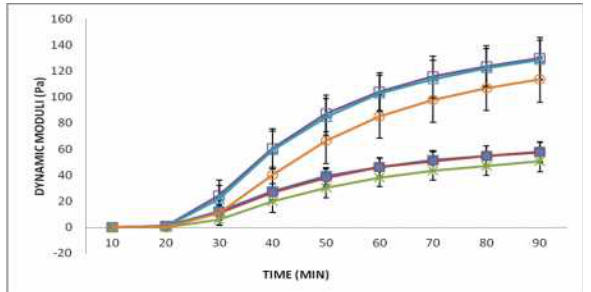
Figure I. Storage modulus (G’) and loss modulus (G”) as a function of time for rennet induced curds made from unfrozen pasteurized ( , ), 1st freeze/thaw cycle ( ,●) and 2nd freeze/thaw cycle buffalo milk ( , ). Results are means of 18 values with error bars for standard deviation.
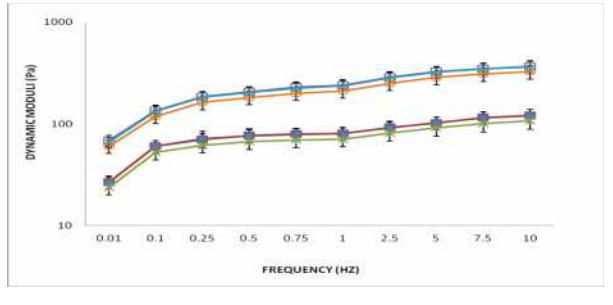
Figure II. Storage modulus (G’) and loss modulus (G”) as a function of frequency for rennet induced curds made from unfrozen pasteurized ( , ), 1st freeze/thaw cycle ( ,●) and 2nd freeze/thaw cycle buffalo milk ( , ). Results are means of 18 values with error bars for standard deviation.
Rearrangements of the existing particles could result in the formation of more contact area between particles (Walstra, 1993). It is also possible that more casein micelles become incorporated in the curd/gel network with time (Zoon et al., 1988a). The dynamic moduli (G”and G’, 57 and 129 Pa respectively after 90 minutes) were approximately equal in unfrozen and 1st freeze/thaw cycle buffalo milk samples. These values were reduced in the 2nd freeze/thaw cycle to 50 and 113 Pa respectively (Fig. I). If the milk is stored for a period at subzero temperatures, it is likely that the protein may be damaged (denatured) during the freeze/thaw cycle, decreasing the interactions present in the protein matrix on curd formation and reducing the overall strength (dynamic moduli) of the curd while essentially maintaining the same type of gel system/interaction type. However it is unclear as to why such “damage” does not occur during the first freezing cycle.
Frequency dependence of small deformation properties of rennet induced curds: When the frequency dependence of the gels (0.01-10 Hz, strain 1%) was examined 90 minutes after rennet addition for the both frozen and unfrozen samples, both the dynamic moduli (G’, G”) and loss tangent (tan δ) of curds were found to be frequency dependent. Figure. II presumably reflects the relaxation of more of the interactions when the time scale of the applied stress is longer (Walstra, 1993). In general in rennet induced curd, both G’ and G” exhibit a power law relation with frequency (Lucey, 2002). Bonds in the matrix have less time to relax if the time scale of applied stress is shorter i.e. both G’ and G” are higher at higher frequencies. All frequency sweeps were characteristic of weak viscoelastic materials (Ferry, 1980) The initial freeze thaw cycle produced very little change in the overall value of the moduli , however the second cycle again shows a reduction in the overall strength of the system (about 12% reduction in G` at 10 Hz). Tan δ was only slightly higher in unfrozen and 1st freeze/thaw cycle than in the 2nd freeze/thaw cycle, 0.34 and 0.33 respectively. All of the samples examined showed the characteristics of “weak” viscoelastic gel systems with the storage modulus predominating over the loss modulus over all of the measured frequency range (0.01-10 Hz).
Effect of freezing and thawing on pH and ionic calcium: When pH was reduced from 6.62 to 6.50 by addition of lactic acid, ionic calcium increased from 4.16 to 4.94 mg/100g (Table II). The relationship between pH and ionic Ca is well established (Fox, 1997). Reduction in pH causes Ca to move out of the casein micelles and leads to an increase in Ca2+ and a reduction in colloidal calcium phosphate, and vice versa. The insoluble calcium/colloidal calcium phosphates are a key bridge material among casein micelles (Dalgleish and Law, 1989). As the pH decreases, there is also a reduction in the electrostatic repulsion between the casein micelles due to a decrease in a net negative charge on the casein by the protonation of negatively charged amino acid residues, phosphoserine (pK≈6.5) and a carboxyl group of glutamic acid (pK≈4.6) (Walstra and Jenness, 1984 & Horne, 1998).
The pH and ionic calcium (both before and after pH adjustment) remained almost constant in unfrozen and 1st freeze/thaw cycle samples but were lower following the 2nd freeze/thaw cycle (Table II). It is suggested that when milk was frozen and thawed a second time, precipitation of calcium phosphate occurred. Hence, the concentration of Ca2+ would decrease giving a final reduction in pH. However, it is not clear why this should occur following the second, but not the first, freeze/thaw cycle.
It may be concluded that freezing/thawing cycle modified internal structure of casein micelles and altered the rheological properties of rennet induced curds made from refrozen buffalo milk. Studies are in progress to determine why these changes occurred following the second, but not the first, freezing cycle.
Acknowledgements: I acknowledged the University of Veterinary and Animal Sciences, Lahore Pakistan for financial support.
REFERENCES
AOAC. (1995). Official method of analysis.16th Ed. AOAC International. Washington, DC.
Bhargava, A. and P. Jelen (1995). Freezing of whey protein concentrate solutions and its effect on protein functionality indicators. Intl. Dairy J. 5:6 533-541.
Chang, B. S., B. S. Kendrick and J. F. Carpenter (1996). Surface induced denaturation of proteins during freezing and its inhibition by surfactant. J. Pharm. Sci. 85: 1325-1330.
Dalgleish, D. G. and A. J. R. Law (1989). PH-induced dissociation of bovine casein micelles. II. Mineral Solubilization and its relation to casein release. J. Dairy Res. 56: 727-735.
Ferry, J. D. (1980). Viscoelastic Properties of Polymers. 3rd Ed. John Wiley & Sons, Inc. Canada.
Fox, P. F. (1997). Advanced Dairy Chemistry: lactose, water, salts and vitamins. 2nd Ed. pp. 233-256. Chapman & Hall, London.
Franks, F., (1985). Biophysics and biochemistry at low temperature. Cambridge University press. London.
Ghatak, P. K .and A. K. Bandyopadhyay (2007). Practical Dairy Chemistry. pp. 1-7. Kalyani Publishers. New Delhi.
Horne, D. S. (1998). Casein interactions: Casting light on the black boxes, the structure in dairy products. Int. Dairy J. 8: 171-177.
Jiang, S. and S. L. Nail (1998). Effect of process conditions on the recovery of protein activity after freezing and freezing-drying. Eur. J Pharm. Biopharm. 45: 249-257.
Lucey, J. A. (2002). Formation and physical properties of milk protein gels. J. Dairy Sci. 85: 281-294.
Muir, D. D. (1984). Reviews of the progress Dairy Science: frozen concentrated milk. J. Dairy Res. 51: 649-664.
Strambini, G. B. and E. Gabellieri (1996). Protein in frozen solutions: evidence of ice induced partial unfolding. Biophys J. 70: 971-976
Van Vliet, T., H. J. M. Van Dijk, P. Zoon and P. Walstra. (1991). Relation between syneresis and rheological properties of particle gels. Colloid Polym. Sci. 269: 620-627.
Walstra, P. and R. Jenness (1984). Dairy Chemistry and Physics. John Wiley and Sons, New York.
Walstra, P. (1993).The syneresis of curd. In Cheese: Chemistry, Physics and Microbiology, 1. General Aspects. 2ndEd. pp. 141-191. Chapman &Hall, London.
Weese,S. J., W. V. Thayne, D. F. Butcher and R. O. Thomas (1969). Effect of freezing and length of storage on milk properties. J. Dairy Sci. 52: 1724.
Weese, S. J., W. V. Thayne and D. F. Butcher (1972). Effect of freezing rate and thawing rate on milk properties. J.Dairy Sci., 56: 2 168 -170.
Zoon, P., T. Van Vliet and P. Walstra (1998b). Rheological properties of rennet- induced skim milk gels. 2. The effect of temperature. Neth. Milk Dairy J. 42: 271-294.
Zoon, P., T. Van Vliet and P.Walstra. (1998a). Rheological properties of rennet- induced skim milk gels. 1. Introduction. Neth. Milk Dairy J. 42: 249-269.