INTRODUCTION
The growing interest about buffaloes in our country, around 70.000 heads of livestock, set the need to enter and improve into the productive system. The productive, reproductive and population parameters in buffaloes (Bubalus bubalis) have not been sufficiently studied in Colombia, for that reason are taken from the cattle. Some Brazilian studies report parameters that are usually applied in buffalo breeding without taking the differences in conditions of production in Colombia, such as quality of land and pastures and the annual variation in the length of light hours according to the station in the center and southern area of Brazil. The aim of this study was to determine productive, reproductive and population parameters in buffaloes (Bubalus bubalis) at the Buffalo Farm Called La Suiza located at the Magdalena Medio in Colombia and make the analysis and interpretation of the indicators and their interactions by subsystems to build a comprehensive understanding of the target farm and perform a control of buffaloes farm operating processes. At the same time indicators about the reproductive, productive and population behavior were establish. Strategic planning was finally used for decision-making and actions by the buffalo company.
MATERIALS AND METHODS
This research was conducted at the Buffalo Farm Called La Suiza located at the Magdalena Medio in Colombia, from January of 2006 until December of 2007. This farm is located at the end of La Sierra, Vereda la Mina, municipalities of Puerto Nare and Puerto Berrío, Department of Antioquia, is composed by 3 farms called: Puerto Alicia, La Espiga and Corinto. The average temperature is 28 ° - 29.3 ° c (IGAC, 2004), the annual average of reported precipitation is 1424 m.m.s to Puerto Berrío, annual relative humidity is 76 % (IDEAM, 2006), with a biannual distribution of the rainy period: March-May, September-November and the dry period: December-February and June-August Vélez, et al., (2007)
The buffaloes population in this farm is composed by four thousand eight hundred animals, distributed so:
La Espiga Farm has a total of 2300 hectares with a population of 1400 animals, where there are pregnant females, female in the dry period and calving, males and females without calving and steers. Corinto farm has a total of 1200 hectares with a population of 1250 animals and Puerto Alicia farm with 1500 hectares and 1100 animals, there are female buffaloes approaching to labor and growing group.
There are 1001 female buffaloes in dairy production, of the total´s population, which are divided into six milking parlours, this group was subject to analysis.
The reproductive, productive and population information of the evaluated group were collected from notebooks, annotations.
They were built each one of the history of individual animals, entered to TaurusWebs software, generated listings for the control by subsystems: inventory of animals, the stories of each one of these, heifers and buffalo cows current information, the inputs and outputs of animals was recorded in the population subsystem.
The production subsystem recorded the following information: current lactations, completed lactations, buffalo cows to dry, animals to wean and weaning animals. The reproduction subsystem recorded the following information: not pregnant buffalo heifers, not pregnant buffalo cows, services, females to be palpate per rectum, pregnant females and calvings. It was done a comparison at the farm to the inventory with the information entered to TaurusWebs software and also information updates was done.
Descriptive statistics was used to analyze the information by subsystems; for that purpose were generated: productivity trees, evaluation for time series and evaluation by calving number.
RESULTS AND DISCUSSION
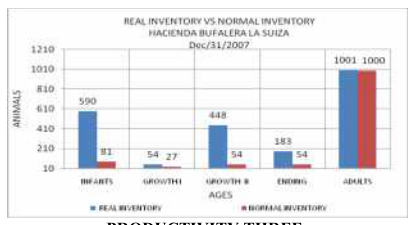
Population subsystem: It seems a female buffalo population in an expansion process with a surplus in the following categories (Table I):
Infants; corresponding to 86% Growth I ; corresponding to 50% Growth II; corresponding to 88% Ending; corresponding to 70%
This excess could be selected by its phenotypic characteristics, age and weight leaving the best specimens in the farm and having the remaining to be sold, then generating an additional income for the farm.
According to the harmonic replacement rate of 11% annual for this farm, 110 buffalo cows should be ruled out and need 110 buffalo heifers for its replacement, there are 129 buffalo heifers surplus, these could be used to expand the herd by an additional 13 per cent or for sale.
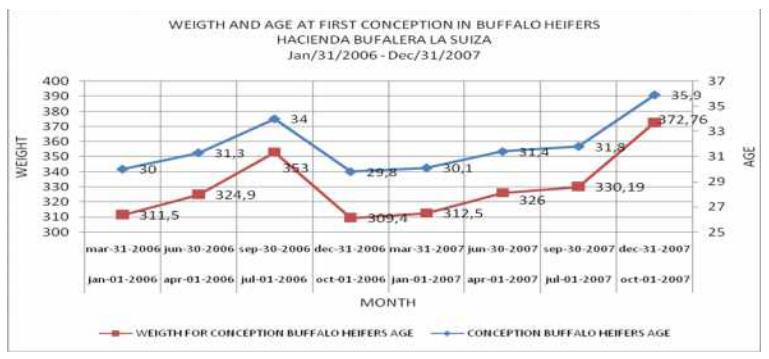
Reproduction subsystem: Buffalo heifers presented an age at first conception of 7.4 months more than the expected according to literature, which causes decrease in productivity to lower number of deliveries occur by all the population.
The weight at the age at first conception is lower than the expected (330 kg) according to 400 kg reported by literature. The sexual behavior connected to puberty, age at first conception, age at first calving is more correlated with the weight reached by the heifers than by age. Therefore, it could be probed that there is not deficiencies on the heifers breeding then it could be reconsider that the weight at the age at first conception can be reduced according to the present investigation.
The age at the first conception is directly proportional to the age at first calving and was ratified reached weight is less than the reported.
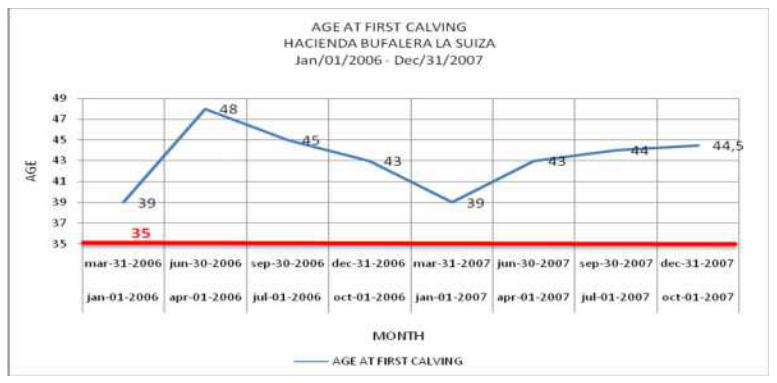
It was found that the average age and weight at the first calving was 44 months (1320 days) and 465 kg, it was reported in literature that an average of 40 months (1200 days) and body weight of 506.9 ± 57.9 Kg Baruselli et al. (1993). In conclusion the low reproductive productivity occurs in females at first calving.
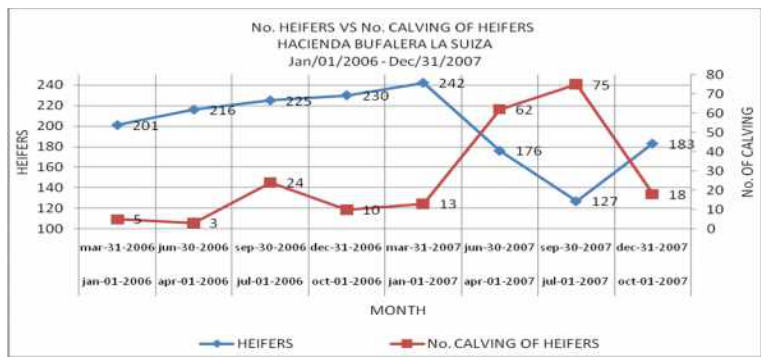
The heifers calvings display a greater presentation in the months of July to September and a lower presentation in the months of January to March consolidating in this way the seasonal reproductive pattern.
The age at the first calving reported is in connection with the higher age at the first conception, differing from Baruselli reported, with an average of 35 months (1050 days) and body weight of 506.9 ± 57.9 Kg Baruselli et al. (1993), this value could be associated with the nutritional deficiencies during the process of growing and ending.
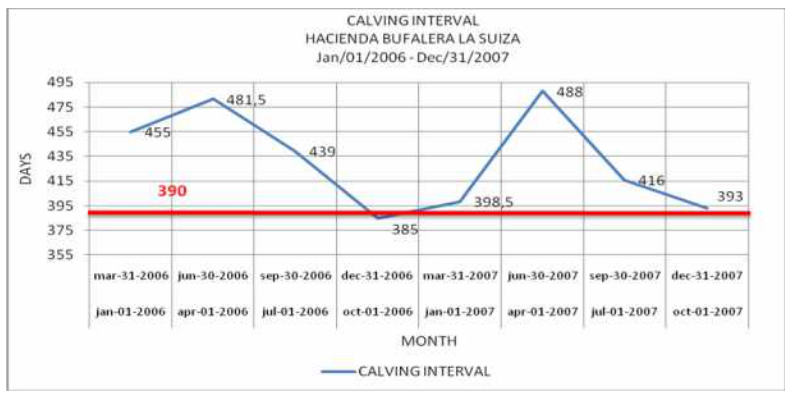
The average intercalving interval found was of 406 days, (Montiel, 2006) reported an average of 390 days, the trend of this indicator is toward increasing, this increase is directly connected with the length of the calving-conception interval, and the increased length of this interval will be greater the length of intercalving interval. The higher in the intercalving interval affect directly the production so that decrease the number of calvings and a lactation loss and is equivalent to an average lactation production of 638.137 liters (Number of Female buffaloes * Days Open (DO) * 2.5 liters).
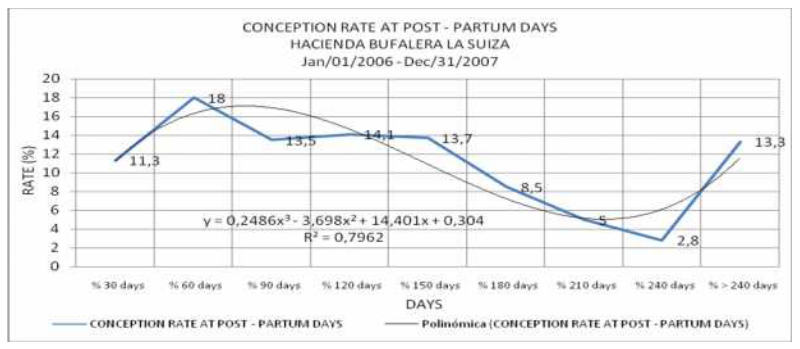
The buffalo cows show problems in the intercalving interval indicator, related with high conception percentages to 90 – 120 – 150 days and with a higher percentage over 240 days.
Milk production subsystem: Findings:
Average of milking buffalo cows: 480 animals.
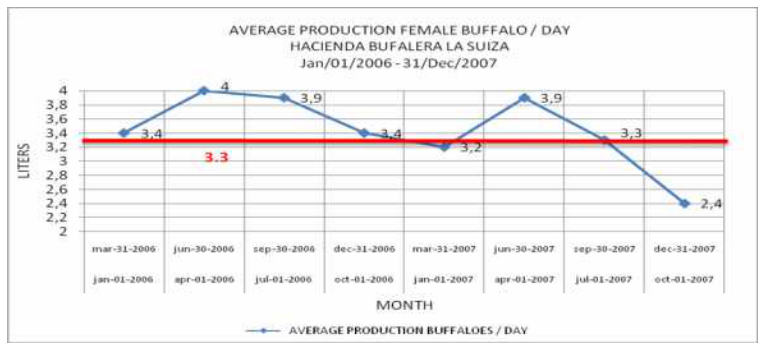
Average of Milking Days:144 days Average production female buffalo/day: 3.3 liters Average milk production/day: 1.598 liters Average total milk production: 1.166.382 liters
1734 lactations were evaluated, with the following results:
Average lactation duration: 284 days.
Average dry period (days): 128 days.
Average completed lactations: 736 liters Average lactation 305 days: 748 liters
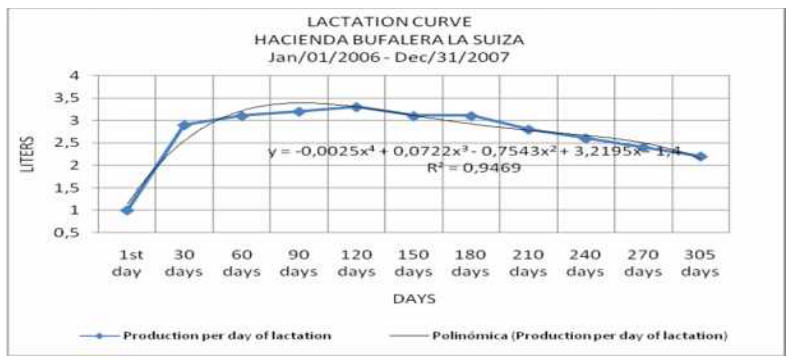
The lactation curve for the analyzed period, started with 1 lt on the 1 day, the peak was with 3.1 liters on the 60 day, the production on the 150 day is 3.1 liters and 240 day production is 2.6 liters.
The greatest concentration period of buffalo cows calvings corresponds to Oct-01-2007 - Dec-31-2007, the calving seasonality effect is reflected in a milk production seasonality and at the same time in the milk production/day and in the total milk production, it was observed that a larger amount of milking buffalo cows do not reflect an increase in the amount of produced liters, because, there is a greater number of calving buffalo cows with fewer milking days and at the same time the milk production/days average must descend. During this period several significant events occur:
The average production female buffalo/day is lower as a result of the habits of this buffalo farm, where the newly buffalo cows calving spent 20 days with their calves at the field, because, it is believed that those females during this period of time are producing colostrum.
The buffalo cows are crossing by the beginning of the dry season, which extends until February, this phenomenon is correlated with the least milk liters per complete lactation quantity produced (500 lts), due to reduced fodder availability.
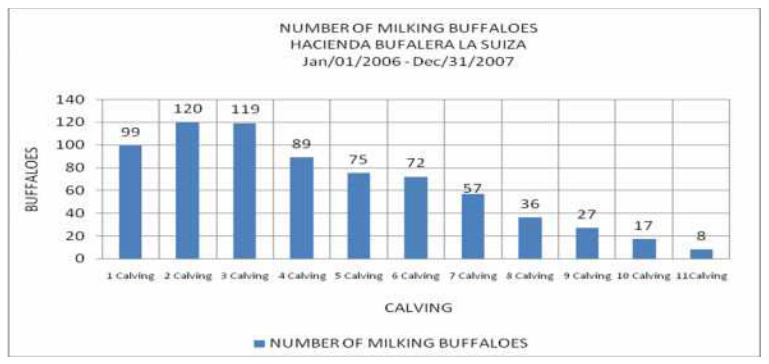
This buffalo farm has a young herd in expansion process, therefore the buffalo cows maintaining the farm production are distributed in the 2, 3 and 4 calving which corresponds to 60 percent of total production and the remaining 40 percent corresponds to 5 – 11 buffalo cows calving.
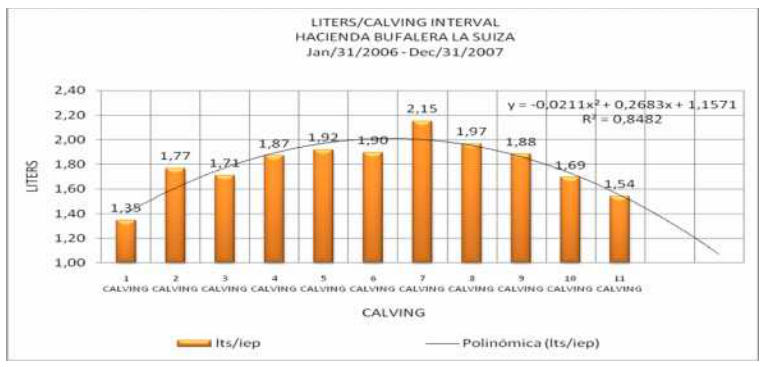
The milking productivity of buffalo cows distributed to their calving number shows than the higher productivity occurs in the 7 calving, since the 8 calving the buffalo cows productivity starts dropping.
Table I. Real inventory vs. Normal inventory. | AGES | Real inventory | Normal inventory1 | Difference | % |
|---|
| INFANTS | 0-9 (months) | 590 | 81 | 509 | 86 |
| GROWTH I | 9-12 (months) | 54 | 27 | 27 | 50 |
| GROWTH II | 12-18 (months) | 448 | 54 | 394 | 88 |
| ENDING | 18-24 (months) | 183 | 54 | 129 | 70 |
| ADULTS | 24 (months or more) | 1001 | 1000 | 1 | 0 |
Table II. Growth Curve | Growth Curve | | Normal Growth Curve | |
|---|
| | % | Average adult weight: 460.9 | Real Growth Curve |
|---|
| 0 | 35.41 | 7% | 31.3 | 30 |
| 205 | 129.21 | 25% | 114.2 | 112 |
| 365 | 220.71 | 42% | 195.1 | 153 |
| 550 | 301.8 | 58% | 266.7 | 198 |
| 730 | 366.38 | 70% | 323.8 | 290 |
| 1460 | 521.52 | 100% | 460.9 | 460 |
Malhado, et al, (2008).
PRODUCTIVITY THREE INCOMES OUTPUTS
110 → 100 → 110
11% 11%
Meat production subsystem: It was found body weights from the moment of the weaning to 365 days with 42.1 kilograms lower than the expected, to 550 days with 68.7 kilograms lower than the expected and to 730 days presents 33.8 kilograms lower than the expected. It is ratified that parenting is poor carried a high age of conception with females with poor development.
From the moment of weaning 365 days 42.1 kilograms lower than expected, 550 68.7 days kilograms below expected and at 730 days present 33.8 kilograms lower than expected. It is ratified that the breeding is poor; carried to a high conception age with females with poor development. (Table II).
Acknowledgements: The authors wish to thanks SADEP LTDA company, for its support and providing the software TaurusWebs to perform this study. Also thanks to the buffalo farm (Hacienda Bufalera La Suiza) for let us did this research on its locations.
REFERENCES
Baruselli, P. S.; J. F. S. Oliveira, M. L. M. Mendes, A. M. Jorge, T. Fujii and J. P. C. Palazzo (1993). Diagnóstico da bubalinocultura do Vale do Ribeira. In: DocumentoTécnico CATI, vol. 94, pp 16. Campinas, Brasil.
Malhado, C., A. Ramos, L. Carneiro, J. Souza, Wechsler, D. Eler, J. Azevêdo, and J. Sereno, (2008). Modelos no lineales para describir el crecimiento de bufalinos de la raza Murrah. In: Arch. Zootec., 57: pp 497-503. Brasil
Montiel, N. (2006). Algunos aspectos reproductivos e Inseminación Artificial en búfalas. In: X Seminario de Pastos y Forrajes, pp 174-186. Maracaibo, Venezuela.