INTRODUCTION
Arsenic (As) is a toxic metalloid, and a broadly distributed pollutant of agricultural soils. Due to geogenic and anthropogenic activities such as mining, industrial emissions, irrigation using As-polluted groundwater, and historical use of As-containing pesticides, As enters into the soil easily. Consequently, soil As contamination poses serious risks to productivity of crops, food safety and human health (Rahman and Singh, 2019; World Health Organization (WHO), 2022; Beiyuan et al., 2023). As occurs in soils largely as arsenate [As(V)] and arsenite [As(III)] forms. Their mobility, bioavailability, and toxicity are controlled by soil physicochemical conditions. Under aerobic conditions, the predominant species of As is arsenate and is primarily taken up by plants through phosphate transporters because of its chemical similarity to phosphate. Under reducing conditions, arsenite is generally more mobile and toxic and enters plant roots primarily through aquaporin channels (Garg and Singla, 2011; Chandrakar et al., 2018). As levels in subsurface water and in agricultural soils are high in South Asia, including Pakistan (Rahman and Singh, 2019; WHO, 2022), where high-As water has been used to irrigate crops.
When plant roots absorb As it can inhibit many physiological and biochemical responses, leading to a decline in plant development. Due to its similar chemistry to phosphate, As(V) inhibits its transport, leading to an alteration in phosphorus metabolism, while arsenite As(III) is easily accommodated in sulfhydryl groups of proteins, causing enzyme inhibition and metabolic impairment (Garg and Singla, 2011). As toxicity also results in excessive production of reactive oxygen species, disrupting membrane stability and damaging chlorophyll (Chandrakar et al., 2018). As toxicity therefore has a negative influence on root development, nutrient uptake, photosynthesis and crop production. Moreover, the food safety issue of As accumulation in plants is of great concern because it is likely to be transferred into the food chain (Khan et al., 2021; Suhel et al., 2023).
Broccoli (Brassica oleracea var. italica) is a nutritionally vital vegetable rich in phytochemicals, dietary fiber and minerals, making it a nutritious vegetable (Chaudhary et al., 2018; Ayadi et al., 2022). With its growing cultivation and direct consumption, it is vital to ensure the productivity of broccoli and prevent the build-up of toxic elements in the edible tissues for viable crop yield and food safety. The As stress not only has an adverse effect on the development of broccoli but also influences its nutrient uptake, photosynthesis and defense mechanisms, leading to a reduction in biomass production and marketable production (Shakeel et al., 2020; Suhel et al., 2023). Thus, enhancing the physiological and biochemical tolerance to As stress while minimizing As uptake by edible parts of broccoli is a key way to promote quality and productivity of the vegetable.
Among the various strategies developed to mitigate As contamination in agricultural soils, BC became a viable soil amendment because of its ability to immobilize toxic elements and improve soil quality (Beiyuan et al., 2023). BC is produced by slow pyrolysis of organic matter under oxygen-limited conditions (Gyanwali et al., 2024). In this research, BC was prepared from Vachellia nilotica wood, a lignocellulosic biomass that can produce a porous material with surface functional groups capable of adsorbing contaminants and influencing their transport in soil. BC can also benefit soil physicochemical properties through adsorption and surface complexation, thereby increasing plant resilience to As stress, enhancing soil nutrient retention, and promoting root growth (Beiyuan et al., 2023).
Chitosan is a naturally occurring biopolymer obtained from chitin, known for its biodegradability, biocompatibility, and capacity to chelate metals (Ghormade et al., 2011; Muthu et al., 2021). Chitosan has been widely explored for the adsorption of toxic metalloids from contaminated water and soil due to having different functional groups (Gerente et al., 2007). For the present study, however, the amendment added is not chitosan alone but ferromagnetic chitosan beads loaded with EDTA. The presence of EDTA and iron oxide can also impact the immobilization of As via complexation, adsorption, and As speciation and mobility, and the magnetic properties of the beads can aid in their recovery (Fan et al., 2018).
Previous studies have examined biochar and chitosan-based materials separately for contaminant adsorption and mitigation of metalloid stress. However, evidence comparing their separate and combined applications in broccoli under As stress remains limited. Therefore, the present study compared biochar and ferromagnetic chitosan-EDTA beads, applied individually and together, for their effects on development, water relations, chlorophyll content and oxidative-stress responses, and offers an integrated assessment of their potential to improve plant resilience to As stress.
MATERIALS AND METHODS
Preparation of ferromagnetic chitosan-EDTA beads (FCEB): Ferromagnetic chitosan-EDTA beads (FCEB) were synthesized by adding 4 g of chitosan powder (Sigma-Aldrich, medium molecular weight, and 75-85% deacetylated) to 100 mL of 2% (v/v) of acetic acid into a beaker. After 20 minutes of stirring, a gel-like solution formed, and 2 g of EDTA (Sigma-Aldrich, analytical grade) and 2 g of iron(III) oxide (Fe₂O₃; Uni-Chem Chemical Reagents, AR grade) were added to it. Afterward, the solution was added to a separating funnel and poured dropwise into the sodium hydroxide solution (1 M). Through an acid-base reaction, the drops were converted into beads, which were then immersed in a 25% (v/v) epichlorohydrin (analytical grade) solution and allowed to crosslink for 12 h, at room temperature under static conditions. Afterward, crosslinked beads were removed from solution, washed with distilled water three times and air-dried at room temperature.
Swelling capacity of ferromagnetic chitosan-EDTA beads: Swelling capacity of beads was assessed following the method of Paneva et al. (2004). The 50 mg dry ferromagnetic chitosan-EDTA beads were placed in buffer solutions at pH 5.5, 7, and 8.5 at 25 °C and were submerged for 1 h, 2 h, 3 h, and 24 h, the excess buffer was carefully removed before weighing the swollen weight of the beads.

Where, Wt is the weight of swollen beads, and Wd is the weight of dry beads.
Preparation of biochar (BC): Biochar was produced from wood pruning of Vachellia nilotica at 450 °C at a constant rate of 20 °C min⁻¹. Wood pieces were rinsed with distilled water, air-dried, and then kept in an oven at 80 °C. The dried wood was cut into pieces about 3 cm. The pyrolysis procedure was conducted for 3 hours using a stainless-steel benchtop tubular fixed-bed reactor. The volatile gases and tars, which were byproducts, were continuously swept out using nitrogen. BC physicochemical properties, such as the pH, electrical conductivity (EC), ash content, Brunauer–Emmett–Teller (BET) surface area, characteristics of pores, and scanning electron microscopy (SEM) analysis, have already been reported for the same V. nilotica BC with the same pyrolysis condition (Jahan et al., 2019).
Experimental design: The experiment was set up in nine treatments with three replicates T₀ As0, T₁ As50 (50 mg As kg⁻¹ dry soil), T₂ As100 (100 mg As kg⁻¹ dry soil), T₃ (50 mg As kg⁻¹ dry soil + biochar), T₄ (100 mg As kg⁻¹ dry soil + biochar), T₅ (50 mg As kg⁻¹ dry soil + ferromagnetic chitosan-EDTA beads), T₆ (100 mg As kg⁻¹ dry soil + ferromagnetic chitosan-EDTA beads), T₇ (50 mg As kg⁻¹ dry soil + biochar + ferromagnetic chitosan-EDTA beads) and T₈ (100 mg As kg⁻¹ dry soil + biochar + ferromagnetic chitosan-EDTA beads). The pot experiment was conducted in the Botanical Garden, University of the Punjab, Lahore, Pakistan adopting a CRD. For each pot with 12 inches diameter, 5 kg of dry soil was used, and each pot served as one experimental unit. As was added in the form of arsenic (III) oxide (As₂O₃). For achieving the As concentration of 50 and 100 mg As kg⁻¹ of dry soil, 0.330 and 0.660 g of As₂O₃ was applied per pot, respectively. The amount was calculated based on elemental As content, knowing that As₂O₃ is made up of 75.74% of elemental As. The required amount of As₂O₃ was mixed well into the soil prior to sowing. The dry BC was applied at 150 g/5 kg soil (3% w/w biochar) and FCEB at 15 g 5 kg⁻¹ soil (3 g kg⁻¹ beads). Five seeds of the broccoli (Brassica oleracea var. italica) F1 hybrid ‘Marathon’ [LOT NO. 764101 (EF267013)] were sown in each pot. Initially, fertilizers for nitrogen, phosphorus and potassium were applied at sowing (diammonium phosphate (DAP), 68 mg kg⁻¹; sulfate of potash (SOP), 62 mg kg⁻¹; and urea, 43 mg kg⁻¹). Later, urea was applied in two splits: 34 mg kg⁻¹ at the early vegetative stage and 34 mg kg⁻¹ at early head initiation. Plants received natural sunlight and were watered on a daily basis. The experiment was continued for 90 days.
Soil analysis: The soil pH and EC were assessed by the Rayment and Higginson (1992) method. Water holding capacity (WHC) was assessed by the Estefan et al. (2013) method. A laboratory drainage method was used to assess the WHC following harvest. After the plant roots were removed, soil was taken from each pot and allowed to air-dry. A 100 g sample of soil was placed in a filter-paper-lined funnel without compaction. The soil was then gradually soaked with a certain amount of water. The extra water was collected in a graduated container and allowed to drain freely after full saturation.

Plant physiological and biochemical attributes:
Estimation of chlorophyll content: The chlorophyll a, b, total and carotenoid content, were estimated by Lichtenthaler and Wellburn (1983) methodology. Briefly, fresh 0.1 g of leaf collected at the vegetative stage was homogenized with 5 mL of 80% (v/v) acetone. After centrifuging the homogenate for five minutes, the supernatant was moved to a cuvette in a spectrophotometer. The absorbance was noted at 663, 645, and 470 nm with a 1 cm optical path-length cuvette in a spectrophotometer.




Where, A663 is absorbance at 663 nm, A645 is absorbance at 645 nm, A470 is absorbance at 470 nm; v is the extract volume (mL), and w is the fresh tissue mass (g). Pigment contents are expressed as mg g⁻¹ fresh weight.
Determination of protein content: The protein content was estimated by following Bradford (1976) procedure. Fresh 0.1 g of leaf was homogenized in 1 mL of the phosphate buffer (pH 7.5). After centrifuging the homogenized mixture for ten minutes at 3000 rpm, 0.5 mL of the supernatant was mixed with 5 mL of Bradford reagent and 0.5 mL of distilled water, afterward the mixture was incubated for 30 min, then absorbance was noted at 595 nm. Protein content was measured with a calibration curve of bovine serum albumin and expressed as mg of protein per g of fresh weight.
Preparation of enzyme extract: Fresh (0.5 g) leaf was crushed in 5 mL of 50 mM phosphate buffer in ice-cold conditions in mortar and pestle. Ice was used for homogenization to reduce enzyme degradation. After centrifuging the homogenate at 13,000 × g for 20 minutes at 4 °C, the supernatant was used for the preparation of enzyme extract in the estimation of superoxide dismutase (SOD) and catalase (CAT).
Determination of the residual-H₂O₂ signal following the CAT reaction and SOD activity: The activity related to CAT was assayed using the residual H₂O₂ procedure followed by Teranishi et al. (1974). In a reaction mixture volume of 3 mL, there were 2.6 mL of 50 mM potassium phosphate buffer, 0.2 mL of 15 mM H₂O₂, and 0.2 mL of enzyme extract. The reaction was stopped after incubating for 5 min by adding 2 mL of titanium reagent. The yellow-colored complex was formed from the remaining H₂O₂. The absorbance was determined at 410 nm against a reagent blank, and expressed in terms of A410 mg⁻¹ protein. The endpoint absorbance was normalized to the protein content of the enzyme extract and noted as a protein-normalized residual-H₂O₂ signal:

Here, A410 represents the endpoint absorbance of the residual-H₂O₂-titanium complex noted at 410 nm.
The SOD activity was assessed by Beauchamp and Fridovich (1971) method. Reaction mixture of 2 mL consisted of 0.2 mL of 13 mM methionine, 0.1 mL of 0.075 mM nitroblue tetrazolium (NBT), 0.2 mL of Triton X-100 (0.1%), 0.1 mL of 0.002 mM riboflavin, 0.1 mL of enzyme extract, and phosphate buffer to get total reaction mixture volume. Reaction mixtures were exposed to light for 15 minutes, and absorbance was recorded at 560 nm. An identical reaction mixture, which was illuminated in the absence of enzyme extract, was used as maximum-photoreduction. One unit of SOD was calculated as an enzyme, which inhibited NBT photoreduction by 50%.



Where, DF = enzyme-extract dilution factor
Determination of ascorbate peroxidase activity (APX): APX activity was determined by the Nakano and Asada (1981) method. In 3 mL of ice-cold 50 mM phosphate buffer (pH 7) containing 0.1 mM EDTA and 1% (w/v) polyvinylpyrrolidone (PVP), a fresh (0.5 g) leaf was homogenized. After centrifuging the homogenate for 15 minutes at 4 °C at 12,000 rpm, the supernatant was collected as the enzyme extract. The mixture (1 mL) contained 700 µL (50 mM) phosphate buffer (pH 7.0), 50 µL (0.1 mM) EDTA, 100 µL of freshly prepared 0.5 mM ascorbate, 100 µL of 0.1 mM hydrogen peroxide (H₂O₂), and 50 µL of enzyme extract. APX activity was calculated on the basis of the reduction in the absorbance value at 290 nm due to ascorbate oxidation. The H₂O₂ addition served as the starting point, and then absorbance was measured for 1–2 minutes. Calculation was based on the ascorbate extinction coefficient value of 2.8 mM⁻¹ cm⁻¹, and the activity was noted as µmol ascorbate oxidized min⁻¹ mg⁻¹ protein.

DF = enzyme-extract dilution factor
2.8 = extinction coefficient of ascorbate, mM⁻¹ cm⁻¹
 = cuvette path length
 = protein contained in the 50-μL enzyme aliquot
Estimation of relative water content (RWC) and electrolyte leakage (EL): The RWC was measured by Weatherley (1950) method. The weight of fresh fully expanded leaves was obtained at the vegetative stage. Afterward, the leaves were placed in petri plates with distilled water for 24 h to ensure complete turgidity. The leaf surface was gently dried, and the turgid weight was noted. The leaves were then oven dried at 70 °C for 72 h to calculate the dry weight (DW).

EL was determined by Premachandra et al. (1990) method. The leaf discs were collected and washed thoroughly with tap water and then with double distilled water to remove the dust, and 100 mg of fresh leaf discs was taken. The leaf discs were placed in test tubes filled with 10 mL of double distilled water and the tubes were placed in a water bath at 40 °C for 30 min. The electrical conductivity (C₁) of the solution was determined. Then they were boiled in a water bath (100 °C) for 10 minutes to completely release the electrolyte, cooled to room temperature and the final electrical conductivity (C₂) was noted.

Estimation of hydrogen peroxide (H₂O₂) content: The content of H₂O₂ was assessed by Velikova et al. (2000) method. Fresh 0.5 g of leaf tissue was crushed using a pre-chilled mortar and pestle in 5 mL of ice-cold 0.1% (w/v) trichloroacetic acid. The clear supernatant was then removed after the homogenate was centrifuged at 12,000 rpm for 15 minutes at 4 °C. The supernatant was mixed with 1 mL (1 M) potassium iodide (KI) and 0.5 mL of (10 mM) potassium phosphate buffer with pH 7.0 to make the test mixture. The reaction mixture was left for half an hour in dark, after which it was observed at 390 nm on a UV-Visible spectrophotometer. To reduce pigment interference, analyses were conducted using the clear supernatant after background absorbance was adjusted using a reagent blank. The H₂O₂ content was noted as µmol g⁻¹ fresh weight by a standard curve of H₂O₂.
Morphological parameters of plant: One representative plant was selected from each pot at 90 days after sowing, corresponding to the head-formation stage, and each pot was treated as an experimental unit. The fresh roots, shoots, leaves and head weights were recorded individually by using an analytical weighing balance. Then, the plants were oven-dried at 70 °C to constant weights for dry biomass determination. Root and shoot lengths were measured by a meter rod. Leaf number was counted manually; leaf area was calculated from digital images of the leaves by using ImageJ software. Head diameter was measured in millimeter by using a digital vernier caliper.
Statistical analysis: The data were subjected to one-way analysis of variance (ANOVA) in Minitab version 21.2 (Minitab LLC, State College, PA, USA). Prior to ANOVA, normality of the residuals and equal variance were tested by applying Shapiro-Wilk test (Shapiro and Wilk, 1965) and Levene’s test (Levene, 1960), respectively. Each treatment had three independent pots, where each pot is the experimental unit. If there was a significant effect among treatments detected by ANOVA, means for each treatment were compared by employing Tukey’s Honestly Significant Difference (HSD) test (Tukey, 1949) at p ≤ 0.05. The results are shown as mean ± SD from three independent biological replicates (n = 3).
RESULTS
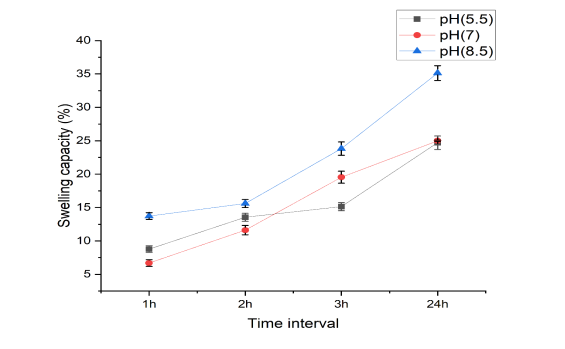
Diameter and swelling test of ferromagnetic chitosan-EDTA beads: The diameter of FCEB was 0.18 ± 0.01 mm. Both pH and immersion time had an effect on the swelling capacity of the FCEB. At 1 h, the swelling capacity was 8.7%, 6.6%, and 13.7% at pH 5.5, 7.0, and 8.5, respectively. After 2 h, the swelling capacity increased to 13.5%, 11.6%, and 15.6%, respectively. At 3 h, the corresponding values were 15.1%, 19.5%, and 23.8%. After 24 h, the swelling capacity reached 24.7%, 25%, and 35.1% at pH 5.5, 7.0, and 8.5, respectively (Fig. 1). It was noted that the swelling capacity in general increased with increasing immersion time, and the highest swelling value was obtained at pH 8.5 after 24 h (35.1%). The beads exhibited higher water absorption under alkaline conditions than at pH 5.5 and 7.
|
|
|
Fig. 1. Swelling capacity of ferromagnetic chitosan–EDTA beads at different pH values (5.5, 7, 8.5) and immersion intervals (1 h, 2 h, 3 h, and 24 h)
Symbols represent treatment means, and error bars represent the standard deviation (SD) of three independent replicates (n = 3).
|
Soil pH: The untreated control showed a neutral pH of 7.17. As treatments caused a noticeable drop in pH, with 50 mg As kg⁻¹ and 100 mg As kg⁻¹ reducing pH to 5.29 and 5.07, respectively (Table 1). However, adding BC and FCEB, either in combination or individually, significantly improved soil pH. The 100 mg As kg⁻¹ + FCEB + BC treatment recorded the highest pH (7.31), bringing the soil condition closer to neutral.
Soil electrical conductivity (EC): EC increased under As treatments, from 0.75 dS m⁻¹ in the control to 0.85 and 0.94 dS m⁻¹ under As50 and As100, respectively. Amendment application decreased EC compared to the As-only applications. The BC and FCEB treatments reduced the EC to 0.75 dS m⁻¹ and 0.58 dS m⁻¹, respectively, and BC + FCEB reduced the soil electrical conductivity to 0.51 dS m⁻¹. Under As100, the BC, FCEB and combined treatments reduced EC to 0.67, 0.53, and 0.46 dS m⁻¹, respectively (Table 1). The reduced EC (0.46 dS m⁻¹) was found under the As100 + BC + FCEB treatment.
Water holding capacity (WHC): The soil WHC was 61 mL kg⁻¹ under control conditions. As stress slightly reduced WHC (59–60 mL kg⁻¹), whereas treatments with BC and FCEB significantly improved it. The highest WHC (75 mL kg⁻¹) was observed in both the 50 mg As kg⁻¹ + BC + FCEB and 100 mg As kg⁻¹ + BC + FCEB treatments (Table 1).
Table 1. Effect of biochar and ferromagnetic chitosan-EDTA beads amendments on soil pH, EC, and WHC in broccoli grown in As₂O₃-treated soil.
|
Treatments
|
pH
|
EC
dS m−1
|
WHC (mL kg−1)
|
|
(As0)
|
7.17±0.04b
|
0.75±0.02bc
|
61±0.72c
|
|
50 mg As kg⁻¹
|
5.29±0.05d
|
0.85±0.05ab
|
59±0.54c
|
|
100 mg As kg⁻¹
|
5.07±0.05e
|
0.94±0.06a
|
60±0.43c
|
|
50 mg As kg⁻¹ + BC
|
7.2±0.04ab
|
0.75±0.03bc
|
64±0.62b
|
|
100 mg As kg⁻¹ + BC
|
6.91±0.06c
|
0.67±0.04cd
|
65±0.71b
|
|
50 mg As kg⁻¹ + FCEB
|
7.23±0.04ab
|
0.58±0.04df
|
73±1.32a
|
|
100 mg As kg⁻¹ + FCEB
|
7.11±0.05b
|
0.53±0.03ef
|
73±1.45a
|
|
50 mg As kg⁻¹ + BC + FCEB
|
7.17±0.04b
|
0.51±0.01ef
|
75±1.35a
|
|
100 mg As kg⁻¹ + BC + FCEB
|
7.31±0.05a
|
0.46±0.03f
|
75±1.42a
|
Values are presented as mean ± standard deviation (SD) of three biological replicates (n = 3). Means followed by the same letter are not significantly different according to Tukey’s HSD test (p ≤ 0.05).
Abbreviations: EC = electrical conductivity, WHC = water-holding capacity, BC = biochar, FCEB = ferromagnetic chitosan-EDTA beads
Photosynthetic pigments: Relative to As0, As50 reduced chlorophyll a, chlorophyll b, total chlorophyll and the chlorophyll a/b ratio by approximately 43.9%, 37.5%, 43% and 6.5%, respectively. The corresponding reductions under As100 were approximately 63.4%, 50%, 60.7% and 24.4%, respectively. In contrast, carotenoid content was 22.5% and 18.1% higher under As50 and As100, respectively, than under As0.
The application of BC resulted in an improvement in chlorophyll a of 197.8% and 370% compared to As50 and As100 only treatments, respectively, whereas the amount of chlorophyll b increased 166.7% and 241.7% under the same treatments, respectively, and chlorophyll a/b ratio increased 9.6% and 34.6% under the same treatments, respectively. Likewise, application of FCEB brought about an increase in chlorophyll a by 223.9% and 426.7%, chlorophyll b by 186.7% and 283.3%, total chlorophyll content by 214.8% and 385.7% under As50 and As100, respectively, compared to the control As-only treatments (Table 2). The combination of BC and FCEB treatments increased the chlorophyll a, chlorophyll b, total chlorophyll content and chlorophyll a/b ratio by 234.8%, 193.3%, 224.6%, and 11.5% respectively under As50, and 340%, 241.7%, 311.9%, and 28.0% respectively under As100 when compared against the respective As-only treatments. Amendment-induced changes in carotenoid content were comparatively small. Relative to the corresponding As50-only treatment, carotenoid content decreased by approximately 4.7%, 3.6% and 3.6% in BC, FCEB, and BC + FCEB application, respectively. Under As100, carotenoid content decreased by 0.6% with BC, increased by 0.6% with FCEB and decreased by 7.4% with BC + FCEB.
Table 2. Effect of biochar and ferromagnetic chitosan-EDTA beads amendments on Chl a, Chl b, Chl a/Chl b, and Total Chl content and carotenoid content (fresh weight basis) in broccoli grown in As₂O₃-treated soil.
|
Treatments
|
Chl a
(mg g−1)
|
Chl b
(mg g−1)
|
Chl a/Chl b ratio
|
T Chl content
(mg g−1)
|
Carotenoid Content (mg g−1)
|
|
(As0)
|
0.82±0.13ᵇ
|
0.24±0.04ᵇ
|
3.36±0.05ᵃ
|
1.07±0.18b
|
1.38±0.01ᵇ
|
|
50 mg As kg⁻¹
|
0.46±0.02ᵇᶜ
|
0.15±0.03ᵇᶜ
|
3.14±0.60ᵃᵇ
|
0.61±0.03ᶜd
|
1.69±0.04ᵃ
|
|
100 mg As kg⁻¹
|
0.30±0.02ᶜ
|
0.12±0.01ᶜ
|
2.54±0.25ᵇ
|
0.42±0.02d
|
1.63±0.02ᵃ
|
|
50 mg As kg⁻¹ + BC
|
1.37±0.21ᵃ
|
0.40±0.06ᵃ
|
3.44±0.05ᵃ
|
1.77±0.27ᵃ
|
1.61±0.04ᵃ
|
|
100 mg As kg⁻¹ + BC
|
1.41±0.26ᵃ
|
0.41±0.07ᵃ
|
3.42±0.04ᵃ
|
1.82±0.33ᵃ
|
1.62±0.04ᵃ
|
|
50 mg As kg⁻¹ + FCEB
|
1.49±0.09ᵃ
|
0.43±0.03ᵃ
|
3.44±0.02ᵃ
|
1.92±0.11ᵃ
|
1.63±0.01ᵃ
|
|
100 mg As kg⁻¹ + FCEB
|
1.58±0.17ᵃ
|
0.46±0.05ᵃ
|
3.43±0.01ᵃ
|
2.04±0.22ᵃ
|
1.64±0.03ᵃ
|
|
50 mg As kg⁻¹ + BC + FCEB
|
1.54±0.11ᵃ
|
0.44±0.04ᵃ
|
3.50±0.02ᵃ
|
1.98±0.15ᵃ
|
1.63±0.02ᵃ
|
|
100 mg As kg⁻¹ + BC + FCEB
|
1.32±0.14ᵃ
|
0.41±0.02ᵃ
|
3.25±0.17ᵃ
|
1.73±0.16ᵃ
|
1.51±0.19ᵃᵇ
|
|
Values are presented as mean ± standard deviation (SD) of three biological replicates (n = 3). Means followed by the same letter are not significantly different according to Tukey’s HSD test (p ≤ 0.05).
BC = biochar, FCEB = ferromagnetic chitosan-EDTA beads
|
|
|
|
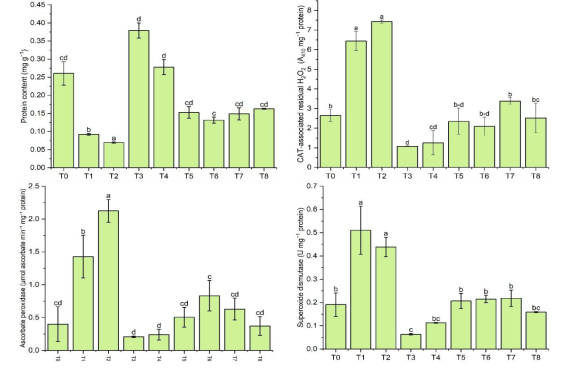
Fig. 2. Effect of biochar and ferromagnetic chitosan-EDTA beads amendments on protein content, catalase (CAT)-associated residual-H₂O₂ response, superoxide dismutase (SOD) and ascorbate peroxidase (APX) activity in broccoli grown in As₂O₃-treated soil. Bars represent means, and error bars represent the standard deviation (SD) of three biological replicates (n = 3). Means followed by the same letter are not significantly different according to Tukey’s HSD test (p ≤ 0.05).
T₀ (As0), T₁ (50 mg As kg⁻¹), T₂ (100 mg As kg⁻¹), T₃ (50 mg As kg⁻¹ + biochar), T₄ (100 mg As kg⁻¹ + biochar), T₅ (50 mg As kg⁻¹ + ferromagnetic chitosan-EDTA beads), T₆ (100 mg As kg⁻¹ + ferromagnetic chitosan-EDTA beads), T₇ (50 mg As kg⁻¹ + biochar + ferromagnetic chitosan-EDTA beads) and T₈ (100 mg As kg⁻¹ + biochar + ferromagnetic chitosan-EDTA beads).
Protein content and antioxidant enzyme assays: Relative to As0, protein content decreased by 64.7% and 73.5% under As50 and As100, respectively (Fig. 2). Relative to As0, the protein-normalized residual-H₂O₂ signal following the CAT reaction increased by approximately 143% and 181% under As50 and As100, respectively. The SOD activity increased by approximately 167% and 129%, whereas APX activity increased by approximately 257% and 431% under As50 and As100, respectively (Fig. 2). Amendment application significantly reduced this residual-H₂O₂ signal relative to corresponding As-only treatments. BC reduced the residual-H₂O₂ signal by 83% under both As50 and As100. FCEB reduced it by 64% and 72%, whereas the combined BC + FCEB treatment reduced it by approximately 47% and 66% under As50 and As100, respectively. Lower protein-normalized residual-H₂O₂ signals should be interpreted as assay endpoints rather than direct measurements of CAT activity. The SOD activity showed reductions of 88% and 74% with BC, 60% and 51% with FCEB, and 57% and 64% with BC + FCEB under As50 and As100, respectively. The APX activity (Fig. 2) exhibited declines of 85% and 89% with BC, 65% and 61% with FCEB, and 56% and 82% with BC + FCEB under As50 and As100, respectively.
|
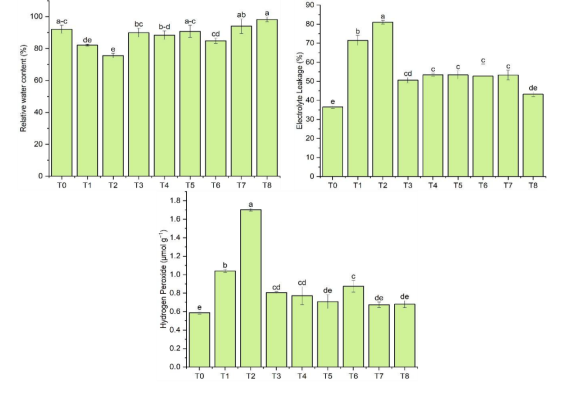
Plant water status: The combined BC + FCEB treatment resulted in the highest RWC, 94% and 98% with As50 and As100 stress, respectively. The As50 (82.2%) and As100 (75.6%) treatments had significantly lower RWC values. The combined treatment of BC and FCEB led to the enhancement of RWC by around 14.4% and 29.6% under As50 and As100 stresses, respectively, as compared to the corresponding As-only treatments (Fig. 3).
Plant stress indicators
Electrolyte leakage (EL): The highest EL% was recorded under the As100 treatment (81%), followed by As50 (71.44%), which also showed substantially elevated EL (Fig. 3). Amendment treatments notably reduced EL%: As100 + BC + FCEB reduced EL% by 46.7% compared to As100. The As100 + FCEB reduced EL% by 35% relative to As100. The As100 + BC reduced EL% by 34% compared to As100 (Fig. 3). Under As50 conditions, the As50 + BC + FCEB reduced EL% by 25% compared to As50. The As50 + FCEB treatment reduced EL% by 25.2% relative to As50. The As50 + BC treatment reduced EL% by 29% compared to As50. The lowest EL% was observed in the control (36.5%) and As100 + BC + FCEB (43%) treatments.
Hydrogen peroxide: As stress significantly increased hydrogen peroxide (H₂O₂) levels in broccoli leaves (Fig. 3), indicating enhanced oxidative stress. The As100 treatment showed the highest accumulation (1.70 µmol g⁻¹), representing a 188.1% increase over the control (0.59 µmol/g), while As50 showed a 76.27% increase (Fig. 3). When comparing BC, FCEB, and combined BC + FCEB treatments to their respective As levels, there was a considerable decline in H₂O₂ content. Compared to As50 (1.04 µmol g⁻¹), As50 + BC (0.805 µmol g⁻¹) reduced H₂O₂ by 22.6%, As50 + FCEB (0.708 µmol g⁻¹) reduced H₂O₂ content by 31.9%, and As50 + BC + FCEB (0.673 µmol g⁻¹) decreased H₂O₂ content by 35.3%. Compared to As100 (1.70 µmol g⁻¹), As100 + BC (0.772 µmol g⁻¹) reduced H₂O₂ by 54.6%, As100 + FCEB (0.874 µmol g⁻¹) by 48.7%, and As100 + BC + FCEB (0.680 µmol g⁻¹) by 60.1%.
Plant growth and yield indicators: As stress markedly reduced all growth and yield parameters presented in Table 3. Relative to As0, As50 reduced shoot and root length, leaf, shoot and root dry weight, head diameter, and head fresh weight by 28.6%, 43.8%, 89.7%, 94.9%, 86.7%, 41.4%, and 24.8%, respectively. The corresponding reductions under As100 were 50.6%, 64.6%, 95.2%, 97.2%, 94.7%, 53.4%, and 75.8%, demonstrating more severe growth and yield inhibition at the higher As concentration.
Under As50, BC increased shoot and root length by 18% and 31.6%, the three dry-weight traits by 83.3–205.6%, head diameter by 37.7%, and head fresh weight by 64.8%. FCEB increased shoot and root length by 29.4% and 51.3%, dry weights by 272.2–296.2%, head diameter by 38%, and head fresh weight by 59.1%. The combined BC + FCEB treatment increased shoot length and root length by 25.2% and 50.1%, leaf, shoot, and root dry weights by 411.5%, 533.3%, and 436.7%, and head diameter and fresh weight by 38.3% and 84.8%, respectively. Under As100, BC increased shoot and root length by 33.3% and 43.7%, dry weights by 125%–158.3%, head diameter by 32.7%, and head fresh weight by 245.2%. FCEB produced increases of 48.6% and 49.4% in shoot and root length, 180%–591.7% in dry weights, 56.2% in head diameter, and 159.3% in head fresh weight. BC + FCEB gave the greatest overall recovery under As100, increasing shoot and root length by 59.2% and 84.6%, leaf, shoot, and root dry weights by 941.7%, 750%, and 550%, and head diameter and fresh weight by 43.8% and 435.7%, respectively.
|
|
|
Fig. 3. Effect of biochar and ferromagnetic chitosan-EDTA beads amendments on relative water content, electrolyte leakage, and hydrogen peroxide content in broccoli grown in As₂O₃-treated soil. Bars represent means, and error bars represent the standard deviation (SD) of three biological replicates (n = 3). Means followed by the same letter are not significantly different according to Tukey’s HSD test (p ≤ 0.05).
T₀ (As0), T₁ (50 mg As kg⁻¹), T₂ (100 mg As kg⁻¹), T₃ (50 mg As kg⁻¹ + biochar), T₄ (100 mg As kg⁻¹ + biochar), T₅ (50 mg As kg⁻¹ + ferromagnetic chitosan-EDTA beads), T₆ (100 mg As kg⁻¹ + ferromagnetic chitosan-EDTA beads), T₇ (50 mg As kg⁻¹ + biochar + ferromagnetic chitosan-EDTA beads) and T₈ (100 mg As kg⁻¹ + biochar + ferromagnetic chitosan-EDTA beads).
|
Table 3. Effect of biochar and ferromagnetic chitosan-EDTA beads amendments on plant growth and yield parameters in broccoli grown in As₂O₃-treated soil.
|
Treatments
|
Shoot length
(cm plant-1)
|
Root length
(cm plant-1)
|
Leaf Dry Wt. (g plant-1)
|
Shoot Dry Wt. (g plant-1)
|
Root Dry Wt. (g plant-1)
|
Head diameter (mm)
|
Head Fresh Wt. (g plant-1)
|
|
(As0)
|
16.67±1.53ᵃ
|
14.70±0.76ᵃ
|
2.52±0.24ᵃ
|
3.51±0.34ᵃ
|
2.26±0.13ᵃ
|
34.30±1.03ᵃ
|
9.95±1.05ᵇᶜ
|
|
50 mg As kg⁻¹
|
11.90±0.76ᵈᵉ
|
8.26±0.21ᵈᵉ
|
0.26±0.03ᵉᶠ
|
0.18±0.03ᵉ
|
0.30±0.07ᶠᵍ
|
20.1±0.95ᵈᵉ
|
7.48±0.27ᵈ
|
|
100 mg As kg⁻¹
|
8.23±0.81ᶠ
|
5.20±0.60ᶠ
|
0.12±0.03ᶠ
|
0.10±0.01ᵉ
|
0.12±0.02ᵍ
|
16±1.00ᵉ
|
2.41±0.10ᵉ
|
|
50 mg As kg⁻¹ + BC
|
14.04±0.17ᵃᵇᶜᵈ
|
10.87±0.75ᵇᶜ
|
0.53±0.05ᵈᵉ
|
0.55±0.13ᶜᵈ
|
0.55±0.06ᵉ
|
27.67±2.52ᵇ
|
12.33±1.56ᵃ
|
|
100 mg As kg⁻¹ + BC
|
10.97±0.93ᵉᶠ
|
7.47±0.35ᵉ
|
0.27±0.04ᵉᶠ
|
0.23±0.05ᵈᵉ
|
0.31±0.04ᶠᵍ
|
21.23±1.20ᶜᵈ
|
8.32±0.78ᶜᵈ
|
|
50 mg As kg⁻¹ + FCEB
|
15.40±0.96ᵃᵇ
|
12.50±1.00ᵇ
|
1.03±0.06ᵇᶜ
|
0.67±0.04ᶜ
|
1.12±0.11ᶜ
|
27.73±1.40ᵇ
|
11.90±0.40ᵃᵇ
|
|
100 mg As kg⁻¹ + FCEB
|
12.23±1.50ᶜᵈᵉ
|
7.77±0.31ᵉ
|
0.83±0.10ᶜᵈ
|
0.28±0.04ᵈᵉ
|
0.43±0.05ᵉᶠ
|
25±1.00ᵇᶜ
|
6.25±0.15ᵈ
|
|
50 mg As kg⁻¹ + BC + FCEB
|
14.90±0.85ᵃᵇᶜ
|
12.40±0.46ᵇ
|
1.33±0.06ᵇ
|
1.14±0.06ᵇ
|
1.61±0.10ᵇ
|
27.8±2.17ᵇ
|
13.82±0.77ᵃ
|
|
100 mg As kg⁻¹ + BC + FCEB
|
13.10±0.53ᵇᶜᵈᵉ
|
9.60±0.44ᶜᵈ
|
1.25±0.15ᵇ
|
0.85±0.06ᵇᶜ
|
0.78±0.05ᵈ
|
23±0.65ᶜᵈ
|
12.91±0.80ᵃ
|
Values are presented as mean ± standard deviation (SD) of three biological replicates (n = 3). Means followed by the same letter are not significantly different according to Tukey’s HSD test (p ≤ 0.05). BC = biochar, FCEB = ferromagnetic chitosan-EDTA beads
DISCUSSION
Biochar (BC), ferromagnetic chitosan-EDTA beads (FCEB), and especially their combination significantly improved plant growth. In the present study, soil pH decreased at As concentrations of 50 and 100 mg kg-1 in comparison to control, thereby increasing soil acidity. However, the use of BC and FCEB, especially when used together, brought soil pH back to near-neutral levels. The treatment with BC and FCEB amendments also caused a slight decrease in EC, while the As-only treatments resulted in a slight increase (Ahmad et al., 2014; Fatima et al., 2026). Moreover, the combined amendments markedly increased WHC, demonstrating their effectiveness in improving soil physical properties. This enhancement is related to the porous structure of biochar, which not only increases soil porosity but also its aggregation and organic carbon content, leading to better water retention and providing better conditions for plant growth under As stress (Beesley et al., 2010; Blanco-Canqui, 2017).
In the present research, it is noted that As toxicity was associated with the plant’s photosynthetic machinery, particularly by reducing chlorophyll levels. The findings agreed with Srivastava et al. (2013), who stated that As toxicity can adversely disturb the photosynthetic pigments. Chlorophyll was reduced in both treatments (As50 and As100), indicating strong inhibition of pigment synthesis, possibly due to damage to chloroplast function.
Under As toxicity, broccoli exhibited a pronounced reduction in total soluble protein content, which disrupts cellular metabolism and protein synthesis. Previous research by Farooq et al. (2016) reported that As toxicity can disturb protein metabolism and other cellular structures. Specifically, As(III) reacts with the sulfhydryl (-SH) groups in the protein, thus causing structural changes in protein and blocking enzymatic action. As may also inhibit nitrate and nitrite reductase actions and cause protein breakdown; hence, the reduction in protein content (Zhao et al., 2009; Abbas et al., 2018). All amendments increased protein content relative to the corresponding As-only treatments; however, BC alone produced the greatest recovery under both As levels. In the present study, the higher protein content following application of amendments may reflect an overall improvement in plant physiological and nutritional status. However, N assimilation, protein biosynthesis and protein degradation were not directly determined; therefore, these mechanisms cannot be confirmed from the current results.
The current research showed that SOD and APX enzyme activities were considerably enhanced in As-exposed broccoli. The corresponding increase in the protein-normalized residual-H₂O₂ signal in the CAT assay represents an endpoint response and does not independently establish decreased CAT activity. The SOD mediates the dismutation of superoxide radicals (O₂⁻) to hydrogen peroxide, which is then detoxified by CAT and APX (Li et al., 2021). Our results are consistent with previous research in wheat, in which SOD and APX activities were upregulated under lead stress (Navabpour et al., 2020). However, despite this upregulation, H₂O₂ still accumulated, indicating that the antioxidant response was insufficient to completely neutralize the excessive ROS burden in As-treated broccoli.
A decrease in the level of endogenous H₂O₂ in plants treated with amendments was concomitant with the decreased SOD and APX activity and decreased signal for residual H₂O₂ in the CAT assay. These changes are consistent with altered oxidative-stress responses (Gill and Tuteja, 2010), although the protein-normalized residual-H₂O₂ endpoint alone does not demonstrate increased CAT-mediated H₂O₂ degradation. It is possible that BC might play a vital role in this process through the improvement of soil properties and the adsorption of inorganic nutrients (Blanco-Canqui, 2017; Hussain et al., 2017).
Under stress, the RWC of broccoli plants decreases in contrast to control plants. The decline may be due to impaired root water uptake and cellular dehydration caused by As-induced oxidative damage. As may affect cell membrane permeability of the roots, resulting in reduced water transport and loss of turgor and cell growth (Vezza et al., 2018). The same effects have been widely documented in other crop plants, such as Brassica juncea and rice, where a significant reduction in RWC was determined at similar concentrations of As (Zulfiqar and Ashraf, 2022). The water deficiency due to As was significantly improved by amendment with BC and FCEB. It is well established that BC improves soil moisture retention and aggregation, which may result in increased water availability in the rhizosphere (Hafez et al., 2020). The improved RWC may also be attributed to the hydrophilic and biocompatible properties of chitosan beads, which may enhance membrane stability and promote water retention under abiotic stress (Hameed et al., 2013).
Under As stress, the EL increased compared with unstressed plants. This is similar to how abiotic stress affects these systems including the ROS which may adversely affect the cell membrane, leading to structural damage, and ion loss (Zulfiqar and Ashraf, 2022). Under high-As stress, BC and FCEB amendments reduced EL. Moreover, chitosan may provide additional antioxidant defenses because its amino and hydroxyl groups assist in radical-scavenging reactions (Xie et al., 2001).
The concentration-dependent reductions in morphological parameters showed that As severely constrained both organ elongation and biomass accumulation. Root growth was particularly sensitive, declining by 43.8% at As50 and 64.6% at As100. As can inhibit meristematic cell division, disturb root structure, nutrient transport, and hormonal regulation, and consequently restrict shoot development (Iqbal et al., 2025). The recovery following BC and FCEB application likely reflects complementary effects in the rhizosphere. BC can increase aeration, water retention capacity, and nutrient availability (Jahan et al., 2019), whereas the amino and hydroxyl groups of FCEB may contribute additional binding sites. This interpretation is consistent with the particularly strong response to BC + FCEB under As100, where shoot and root length rose by 59.2% and 84.6% and dry biomass increased by 550–941.7% relative to As100 alone. The large percentage increases in dry weights should nevertheless be taken in the context of the very low As100 baseline values rather than as complete restoration to the unstressed control.
The head-growth response followed the same stress gradient. Head diameter and fresh weight fell by 41.4% and 24.8% under As50 and by 53.4% and 75.8% under As100, respectively, indicating that severe As stress disproportionately impaired marketable head biomass. Accordingly, BC + FCEB increased head fresh weight by 84.8% under As50 and 435.7% under As100 relative to the respective As-only treatments, although the absolute values should also be considered because the As100 baseline was only 2.41 g. The applied treatments did not directly prove to have effects on As immobilization and plant As uptake, since the concentrations of As in soil and plant tissues were not quantified in the present study, but they did have effects on the plant growth, physiological and antioxidant responses under As stress. Future studies should therefore combine growth and physiological assessments with As quantification.
Conclusion: The application of biochar (BC) or ferromagnetic chitosan-EDTA beads (FCEB) amendments or their combined use contributed towards improving the growth, physiological, biochemical and soil attributes of Brassica oleracea var. italica when grown under nominal treatment of As(III) oxide. Compared to the respective arsenic (As) only treatment conditions, these amendments especially the combined use of these amendments contributed towards increasing chlorophyll content, RWC, plant biomass, head diameter and head fresh weight, while reducing the accumulation of H₂O₂ and electrolyte leakage. These amendments even contributed towards regulating the increased SOD and APX activities seen due to As treatment conditions, suggesting less oxidative stress but not increased antioxidant capacity. However, the levels and bioavailability of As have not been assessed in the soil, roots, shoots or edible parts. Thus, the current results cannot prove any immobilization of As, reduction in plant uptake of As, food safety or remediation efficiency. Further research involving determination of As extractability from the soil and measurement of As content in the plant is needed.
Author contributions: S.J.: Supervision, Resources, Data curation, Conceptualization, and Visualization, Review, Writing, Editing. Z.W.: Writing, original draft, Visualization, Methodology, Software, and Formal analysis. A.K.: Data curation, Conceptualization, and Visualization, Review, Writing, Editing. A.S.: Visualization, Methodology, and Formal Analysis, Review, Writing, Editing.
Acknowledgements: The authors would like to express their gratitude to the University of the Punjab, Lahore for supporting research work.
Funding : This research was financially supported by the University of the Punjab, Lahore, Pakistan.
Conflict of Interest: The authors declare that they have no competing interests.
Data availability: All the data created and analyzed in the present study are included in the manuscript. The other data in this study can be obtained from the corresponding author on reasonable request.
REFERENCES
Abbas, G., B. Murtaza, I. Bibi, M. Shahid, N.K. Niazi, M.I. Khan, M. Amjad, M. Hussain and Natasha (2018). Arsenic uptake, toxicity, detoxification, and speciation in plants: Physiological, biochemical, and molecular aspects. Int. J. Environ. Res. Public Health 15(1): 59. https://doi.org/10.3390/ijerph15010059
Ahmad, M., A.U. Rajapaksha, J.E. Lim, M. Zhang, N. Bolan, D. Mohan, M. Vithanage, S.S. Lee and Y.S. Ok (2014). Biochar as a sorbent for contaminant management in soil and water: A review. Chemosphere 99: 19–33. https://doi.org/10.1016/j.chemosphere.2013.10.071
Ayadi, J., M. Debouba, R. Rahmani and J. Bouajila (2022). Brassica genus seeds: A review on phytochemical screening and pharmacological properties. Molecules 27(18): 6008. https://doi.org/10.3390/molecules27186008
Beauchamp, C. and I. Fridovich (1971). Superoxide dismutase: Improved assays and an assay applicable to acrylamide gels. Anal. Biochem. 44(1): 276–287. https://doi.org/10.1016/0003-2697(71)90370-8
Beesley, L., E. Moreno-Jiménez and J.L. Gomez-Eyles (2010). Effects of biochar and greenwaste compost amendments on mobility, bioavailability and toxicity of inorganic and organic contaminants in a multi-element polluted soil. Environ. Pollut. 158(6): 2282–2287. https://doi.org/10.1016/j.envpol.2010.02.003
Beiyuan, J., Y. Qin, Q. Huang, J. Wang, B. Sarkar, N. Bolan, X. Wu, W. Xu, J. Liu, X. Chen, S. Xu, R. Hu, F. Li, F. Wu and H. Wang (2023). Modified biochar for arsenic immobilization in soil: A critical review. Rev. Environ. Contam. Toxicol. 261(1): 20. https://doi.org/10.1007/s44169-023-00045-x
Blanco-Canqui, H. (2017). Biochar and soil physical properties. Soil Sci. Soc. Am. J. 81(4): 687–711. https://doi.org/10.2136/sssaj2017.01.0017
Bradford, M.M. (1976). A rapid and sensitive method for the quantitation of microgram quantities of protein utilizing the principle of protein-dye binding. Anal. Biochem. 72(1–2): 248–254. https://doi.org/10.1016/0003-2697(76)90527-3
Chandrakar, V., N. Pandey and S. Keshavkant (2018). Plant responses to arsenic toxicity: Morphology and physiology. In: M. Hasanuzzaman, K. Nahar and M. Fujita (eds.), Mechanisms of Arsenic Toxicity and Tolerance in Plants. Springer, Singapore. pp. 27–48. https://doi.org/10.1007/978-981-13-1292-2_2
Chaudhary, A., S. Choudhary, U. Sharma, A.P. Vig, B. Singh and S. Arora (2018). Purple head broccoli (Brassica oleracea L. var. italica Plenck), a functional food crop for antioxidant and anticancer potential. J. Food Sci. Technol. 55(5): 1806–1815. https://doi.org/10.1007/s13197-018-3095-0
Estefan, G., R. Sommer and J. Ryan (2013). Methods of soil, plant, and water analysis: A manual for the West Asia and North Africa region. 3rd Ed. International Center for Agricultural Research in the Dry Areas (ICARDA), Beirut (Lebanon).
Fan, C., K. Li, Y. He, Y. Wang, X. Qian and J. Jia (2018). Evaluation of magnetic chitosan beads for adsorption of heavy metal ions. Sci. Total Environ. 627: 1396–1403. https://doi.org/10.1016/j.scitotenv.2018.02.033
Farooq, M.A., F. Islam, B. Ali, U. Najeeb, B. Mao, R.A. Gill, G. Yan, K.H.M. Siddique and W. Zhou (2016). Arsenic toxicity in plants: Cellular and molecular mechanisms of its transport and metabolism. Environ. Exp. Bot. 132: 42–52. https://doi.org/10.1016/j.envexpbot.2016.08.004
Fatima, N., S. Jahan, A. Kamran, L. Komal and S. Ahmed (2026). Exploring the efficacy of ferrimagnetic chitosan beads and vermichar perlite mix on broccoli (Brassica oleracea L.) growth under chromium stress. Int. J. Phytoremediation 28(5): 836–851. https://doi.org/10.1080/15226514.2025.2585517
Garg, N. and P. Singla (2011). Arsenic toxicity in crop plants: Physiological effects and tolerance mechanisms. Environ. Chem. Lett. 9(3): 303–321. https://doi.org/10.1007/s10311-011-0313-7
Gerente, C., V.K.C. Lee, P. Le Cloirec and G. McKay (2007). Application of chitosan for the removal of metals from wastewaters by adsorption—mechanisms and models review. Crit. Rev. Environ. Sci. Technol. 37(1): 41–127. https://doi.org/10.1080/10643380600729089
Ghormade, V., M.V. Deshpande and K.M. Paknikar (2011). Perspectives for nano-biotechnology enabled protection and nutrition of plants. Biotechnol. Adv. 29(6): 792–803. https://doi.org/10.1016/j.biotechadv.2011.06.007
Gill, S.S. and N. Tuteja (2010). Reactive oxygen species and antioxidant machinery in abiotic stress tolerance in crop plants. Plant Physiol. Biochem. 48(12): 909–930. https://doi.org/10.1016/j.plaphy.2010.08.016
Gyanwali, P., R. Khanal, S. Pokhrel and K. Adhikari (2024). Exploring the benefits of biochar: A review of production methods, characteristics, and applications in soil health and environment. Egypt. J. Soil Sci. 64(3): 855–884. https://doi.org/10.21608/EJSS.2024.270380.1725
Hafez, Y., K. Attia, S. Alamery, A. Ghazy, A. Al-Doss, E. Ibrahim, E. Rashwan, L. El-Maghraby, A. Awad and K. Abdelaal (2020). Beneficial effects of biochar and chitosan on antioxidative capacity, osmolytes accumulation, and anatomical characters of water-stressed barley plants. Agronomy 10(5): 630. https://doi.org/10.3390/agronomy10050630
Hameed, A., M.A. Sheikh, A. Hameed, T. Farooq, S.M.A. Basra and A. Jamil (2013). Chitosan priming enhances the seed germination, antioxidants, hydrolytic enzymes, soluble proteins and sugars in wheat seeds. Agrochimica 57(2): 97–110.
Hussain, M., M. Farooq, A. Nawaz, A.M. Al-Sadi, Z.M. Solaiman, S.S. Alghamdi, U. Ammara, Y.S. Ok and K.H.M. Siddique (2017). Biochar for crop production: potential benefits and risks. J. Soils Sediments 17(3): 685–716. https://doi.org/10.1007/s11368-016-1360-2
Iqbal, M.M., M.A. Farooq, W.D. Khan, U. Ashraf, A.T. Alfaghom and S. Alamri (2025). Maize growth and physiological dynamics: Arsenic uptake modulation under combined abiotic stresses of salinity, boron and arsenic. Environ. Technol. Innov. 37: 103915. https://doi.org/10.1016/j.eti.2024.103915
Jahan, S., S. Iqbal, F. Rasul and K. Jabeen (2019). Structural characterization of soil biochar amendments and their comparative performance under moisture deficit regimes. Arab. J. Geosci. 12(6): 203. https://doi.org/10.1007/s12517-019-4363-7
Khan, I., S.A. Awan, M. Rizwan, S. Ali, X. Zhang and L. Huang (2021). Arsenic behavior in soil-plant system and its detoxification mechanisms in plants: A review. Environ. Pollut. 286: 117389. https://doi.org/10.1016/j.envpol.2021.117389
Levene, H. (1960). Robust tests for equality of variances. In: Contributions to Probability and Statistics: Essays in Honor of Harold Hotelling (I. Olkin, S.G. Ghurye, W. Hoeffding, W.G. Madow and H.B. Mann, eds.). Stanford University Press, Stanford, California, USA. pp. 278–292.
Li, Z., H. Cao, Y. Yuan, H. Jiang, Y. Hu, J. He, Y. Zhang and S. Tu (2021). Combined passivators regulate the heavy metal accumulation and antioxidant response of Brassica chinensis grown in multi-metal contaminated soils. Environ. Sci. Pollut. Res. 28(35): 49166–49178. https://doi.org/10.1007/s11356-021-14193-x
Lichtenthaler, H.K. and A.R. Wellburn (1983). Determinations of total carotenoids and chlorophylls a and b of leaf extracts in different solvents. Biochem. Soc. Trans. 11(5): 591–592. https://doi.org/10.1042/bst0110591
Muthu, M., J. Gopal, S. Chun, A.J.P. Devadoss, N. Hasan and I. Sivanesan (2021). Crustacean waste-derived chitosan: Antioxidant properties and future perspective. Antioxidants 10(2): 228. https://doi.org/10.3390/antiox10020228
Nakano, Y. and K. Asada (1981). Hydrogen peroxide is scavenged by ascorbate-specific peroxidase in spinach chloroplasts. Plant Cell Physiol. 22(5): 867–880. https://doi.org/10.1093/oxfordjournals.pcp.a076232
Navabpour, S., A. Yamchi, S. Bagherikia and H. Kafi (2020). Lead-induced oxidative stress and role of antioxidant defense in wheat (Triticum aestivum L.). Physiol. Mol. Biol. Plants 26(4): 793–802. https://doi.org/10.1007/s12298-020-00777-3
Paneva, D., O. Stoilova, N. Manolova and I. Rashkov (2004). Magnetic hydrogel beads based on chitosan. e-Polymers 4(1): Article 060. https://doi.org/10.1515/epoly.2004.4.1.673
Premachandra, G.S., H. Saneoka and S. Ogata (1990). Cell membrane stability, an indicator of drought tolerance, as affected by applied nitrogen in soyabean. J. Agric. Sci. 115(1): 63–66. https://doi.org/10.1017/S0021859600073925
Rahman, Z. and V.P. Singh (2019). The relative impact of toxic heavy metals (THMs) (arsenic (As), cadmium (Cd), chromium (Cr)(VI), mercury (Hg), and lead (Pb)) on the total environment: an overview. Environ. Monit. Assess. 191(7): 419. https://doi.org/10.1007/s10661-019-7528-7
Rayment, G.E. and F.R. Higginson (1992). Australian laboratory handbook of soil and water chemical methods. Inkata Press, Melbourne.
Shakeel, M., S. Nawaz, Y. Saleem, S. Shafique, A. Tahir and M. Riaz (2020). Broccoli: Introduction and adoption constraints in Pakistan. Sarhad J. Agric. 36(2): 526–532. https://doi.org/10.17582/journal.sja/2020/36.2.526.532
Shapiro, S.S. and M.B. Wilk (1965). An analysis of variance test for normality (complete samples). Biometrika 52(3–4): 591–611. https://doi.org/10.1093/biomet/52.3-4.591
Srivastava, S., A.K. Srivastava, B. Singh, P. Suprasanna and S.F. D’souza (2013). The effect of arsenic on pigment composition and photosynthesis in Hydrilla verticillata. Biol. Plant. 57(2): 385–389. https://doi.org/10.1007/s10535-012-0288-7
Suhel, M., T. Husain, S.M. Prasad and V.P. Singh (2023). GABA requires nitric oxide for alleviating arsenate stress in tomato and brinjal seedlings. J. Plant Growth Regul. 42(2): 670–683. https://doi.org/10.1007/s00344-022-10576-7
Teranishi, Y., A. Tanaka, M. Osumi and S. Fukui (1974). Catalase activities of hydrocarbon-utilizing Candida yeasts. Agric. Biol. Chem. 38(6): 1213–1220. https://doi.org/10.1080/00021369.1974.10861301
Tukey, J.W. (1949). Comparing individual means in the analysis of variance. Biometrics 5(2): 99–114. https://doi.org/10.2307/3001913
Velikova, V., I. Yordanov and A. Edreva (2000). Oxidative stress and some antioxidant systems in acid rain-treated bean plants. Plant Sci. 151(1): 59–66. https://doi.org/10.1016/S0168-9452(99)00197-1
Vezza, M.E., A. Llanes, C. Travaglia, E. Agostini and M.A. Talano (2018). Arsenic stress effects on root water absorption in soybean plants: Physiological and morphological aspects. Plant Physiol. Biochem. 123: 8–17. https://doi.org/10.1016/j.plaphy.2017.11.020
Weatherley, P.E. (1950). Studies in the water relations of the cotton plant. I. The field measurement of water deficits in leaves. New Phytol. 49(1): 81–97. https://doi.org/10.1111/j.1469-8137.1950.tb05146.x
World Health Organization (WHO) (2022). Arsenic. WHO, Geneva, Switzerland. https://www.who.int/news-room/fact-sheets/detail/arsenic
Xie, W., P. Xu and Q. Liu (2001). Antioxidant activity of water-soluble chitosan derivatives. Bioorg. Med. Chem. Lett. 11(13): 1699–1701. https://doi.org/10.1016/S0960-894X(01)00285-2
Zhao, F.J., J.F. Ma, A.A. Meharg and S.P. McGrath (2009). Arsenic uptake and metabolism in plants. New Phytol. 181(4): 777–794. https://doi.org/10.1111/j.1469-8137.2008.02716.x
Zulfiqar, F. and M. Ashraf (2022). Antioxidants as modulators of arsenic-induced oxidative stress tolerance in plants: An overview. J. Hazard. Mater. 427: 127891. https://doi.org/10.1016/j.jhazmat.2021.127891