INTRODUCTION
Livestock sector is considered as the Pakistan’s principal resources (Economic Survey, 2010-2011). Although Pakistan contains handsome number of dairy breeds of cattle but these breeds are low performers in terms of milk production and their genetic potential have been utilized. Milk production of dairy animals can be increased either by increasing the number of milch animals or improving milk production per animal through improving environmental conditions, management practices, and genetics. Undoubtedly, improving environmental conditions and managemental practices would be more effective approach coupled with improving genetic potential of dairy animals. There are various mating systems to improve genetic potential of the dairy animals. Among these, crossbreeding of local non-descript cattle with exotic breeds of high genetic potential is considered to be a rapid and effective method of improvement. Focusing on the need to boost up the milk production of milking breeds, the Pakistani government has established dairy herds of exotic breeds i.e. Holstein Friesian and Jersey at various locations in the country.
Heritability is the key genetic parameters which determine the amount of possible genetic progress for selected traits. Repeatability is a proportion of an individual’s superiority or inferiority for a particular trait that is expected to be expressed next time. As various environmental and genetic factors influence performance traits of dairy cattle, so the present study was aimed to study meticulously the influence of environmental and genetic factors on Holstein Friesian cattle maintained under subtropical conditions of North West Pakistan or Khyber Pakhtunkhwa.
MATERIALS AND METHODS
Source of data: This study was conducted at Agricultural University Dairy Farm Peshawar. Production and reproduction records of Holstein Friesian cattle from 1999 to 2008 were utilized in the study. Traits include lactation milk yield (LMY), lactation length (LL) and dry period (DP) were calculated from the data.
Statistical Model and Experimental Design: Arithmetic means with standard error (± SE) for the above mentioned traits were calculated. The data were analyzed using General Linear Model (GLM) procedure.
The effect of sire, parity, season and year of calving on performance traits was modeled as:
Yijklm = µ + αi + ßj + δk + λl + eijklm Where: Yijklm = the n-th production record of each cow, daughter of i-th sire, j-th parity, calved in k-th year and l-th season of calving; µ = the population all mean; αi = the effect of i-th sire; ßj = the effect of j-th parity; δk= the effect of k-th year of calving; λl= the effect of l-th season of calving; eijklm = Random residual.
Estimation of Heritability and repeatability: The following models were used for calculating heritability (h2 ) and repeatability (r):
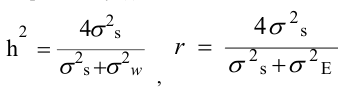
Where: σ2s is the between sire variance; σ2w is the within sire variance; σ2E is within daughters variance.
RESULTS
Lactation Milk Yield: Unadjusted and least square mean for LMY in Holstein Friesian cows was 3438±887.19 kg, ranging between 2042 kg to 6557 kg, with a coefficient of variation of 25.81 percent (Table I). Effect of parity on LMY was found significant (P<0.05) while the effect of sire, season and year of calving was found non-significant (Table II). Parity 7th had a highest average LMY of 4392 kg than other parities. Cows calved in spring had highest LMY than other seasons. Heritability and repeatability estimates for LMY were 0.255±0.328 and 0.261±0.88, respectively (Table I).
Average lactation length: LL of Holstein Friesian cows ranged from 185 to 514 days with mean of 366.5±76.71 days and a coefficient of variation of 20.93 percent (Table I). Season of calving had a significant (P<0.05) effect while sire, parity and year of calving had a non-significant effect on lactation length (Table II). Heritability and repeatability estimates for average LL were 0.184±0.161 and 0.194±0.073, respectively (Table I).
Dry period: Mean DP of Holstein Friesian cow was 100.26±61.38 days, ranging between 32 to 358 days, with a coefficient of variation of 37.12 percent (Table I). Sire and season of calving had significant (P<0.05) effect on dry period while the effect of parity and year of calving was non-significant on DP (Table II). Cows calved in fall season had lowest DP than other seasons. Heritability and repeatability estimates for DP were 0.171±0.204 and 0.198±0.085, respectively (Table I).
Table I: Range, mean±SD, co-efficient of variation, heritability and repeatability of performance traits of Holstein Friesian cows. | Trait | Mean±SD | Range | CV (%) | Heritability | Repeatability |
|---|
| | Min | Max | | | |
|---|
| LMY (kg) | 3438±887.19 | 2042 | 6557 | 25.81 | 0.255±0.328 | 0.261±0.088 |
| LL (days) | 366.5±76.71 | 185 | 514 | 20.93 | 0.184±0.161 | 0.194±0.073 |
| DP (days) | 100.26±61.38 | 32 | 258 | 37.12 | 0.171±0.204 | 0.198±0.085 |
LMY= lactation milk yield, LL= lactation length, DP= Dry period
Table II: Analysis of variance of LMY, LL and DP of Holstein Friesian cattle affected by sire, parity, season and year of calving | Source of variation | Lactation Milk Yield | Lactation Length | Dry Period |
|---|
| DF | MS | P | DF | MS | P | DF | MS | P |
| Sire | 8 | 701401.31 | 0.526 | 8 | 4853.97 | 0.582 | 8 | 13471.03 | 0.012 |
| Parity | 6 | 1686088.49 | 0.045 | 6 | 3676.25 | 0.710 | 5 | 11550.65 | 0.053 |
| Season | 3 | 1231048.65 | 0.201 | 3 | 17802.74 | 0.032 | 3 | 14587.34 | 0.036 |
| Year | 9 | 273538.63 | 0.956 | 9 | 2068.12 | 0.955 | 8 | 59783.76 | 0.319 |
| Residual | 119 | 787121.81 | - | 119 | 5884.59 | - | 24 | 5056.28 | - |
| Total | 145 | - | - | 145 | - | - | 104 | - | - |
DISCUSSION
Lactation milk yield: It was reported that the range of average LMY was from 2772.76 kg to 3710 kg (Sattar et al. 2005, Abdullah (2005) and Tadesse et al. 2010). LMY in this study was in line with above mentioned studies. Javed et al. (2004) and Tadesse et al. (2010) reported significant effect of calving season and parity on LMY. In the present study, the highest LMY in parity 7 was probably due to fewer records available. The results indicate that milk production was high in parity 2nd and 3rd. Javed et al. (2002) and Javed et al. (2004) pointed out that the adoptability and performance of temperate breeds in the subtropics was not satisfactory. The milk production was high in spring and fall indicating that environmental temperature was suitable for Friesian breed during these seasons. Whereas, environmental deviations (heat stress in summer especially) coupled with fodder scarcity were the main reasons for low milk production. Efforts should be made to reduce tropical environmental stresses. In summer sprinklers (droplets) and fresh air flow should be ensured to minimize heat stress for the animals to give maximum production. The non-significant effect of year of calving on LMY revealed that the management during these years was the same. Non-significant effect of sire on LMY indicated that no improvement was made in genetics through the use of sire. Use of imported semen from temperate regions may increase the production but again the adoptability remains questioned, therefore, use of local produced semen from elite animals through intensive selection based on large no of data available will insure both the increase production as well as adoptability under prevailing conditions.
The heritability ranged widely from 0.06 to 0.47 (Bakir et al. 2004, Lakshmi et al. 2009, Cilek and Sahi 2009). Moderate heritability was estimated in the study. Repeatability was widely ranged from 0.047 to 0.21 (Abdullah (2005), Ferreira et al. 2000, El-Barbery et al. 1999). Repeatability estimates for LMY were low showing lack of improper environmental conditions. Selection for LMY could not be justified due to the relatively lesser records available in the study.
Lactation length: The range of LL was reported from 291.86 to 362 (Tadesse and Dessie 2003, Qureshi et al. 2002, Sattar et al. 2005). The average LL in the study was in similar range with the above mentioned studies. Lakshmi et al. (2009) reported that parity showed significant (P<0.05) effect on LL. Lactation length was found sensitive to the seasonal variations. Cows calved in fall and winter had comparatively low LL due to the reason of better feeding that led to early conception of these cows resulting in an on time subsequent calving. The probable reason for this high LL may be missing heats, improper timely insemination and repeat breeding.
Lakshmi et al. (2009) and Katoch et al. (1990) reported heritability of 0.06 and 0.181±0.162 for LL. The range of repeatability was from 0.06 to 0.22 (El-Barbary et al. 1999, Galip et al. 2004). The results in the study were similar with above studies. Moderate heritability estimates for LL indicated that larger proportion of phenotypic variance was due to environment and improvement through direct selection would be slow. The low repeatability estimate of LL revealed that LL was highly influenced by environment.
Dry period: The range of DP was from 129.63 to 281.33 (Niazi and Aleem 2003, Sattar et al. 2005, Abdullah (2005), Suhail et al. 2010). Dry period of 100.26±61.38 in this study was lower than these studies. Suhail et al. (2010) reported non-significant effect of sire, season and year of calving on dry period. DP of cows calved in fall was low probably due to the reason that their drying up time fall in summer with high temperature and inadequate green fodder. Attempts to good dry period through better reproductive management would certainly reduce length of calving interval, thus adding in profitability of the farm.
Deokar and Ulmek (1997) and Suhail et al. (2010) reported the estimated heritability value of 0.08±0.12 and 0.101±0.21 for DP in Holstein Friesian and Jersey cows, respectively. Heritability estimate for DP in the study was in normal range to these studies. Abdullah (2005) and Khan et al. (1995) reported repeatability estimates of 0.5531±0.0659 and 0.02 to 0.46 in Holstein and crossbred cows, respectively. Low repeatability values were probably due to fewer records available for DP.
Conclusions: Higher standard error of heritability estimates and low to moderate repeatability estimates for all the traits under study indicated that these traits were highly influenced by environmental factors and evaluation should be made when more records are available. All the traits were influenced by subtropical environmental factors therefore, minimizing subtropical environmental stresses especially in summer by ensuring the use of sprinklers, fresh air flow, 24 hour access to clean water and better housing will decrease the heat stresses common in the study area. Besides environmental factors, national data bank should be maintained through improved data recording system. Based on large bulk of data elite sires could be selected in the prevailing conditions for desirable genotype both in term of production and adaptability in the subtropics.
Acknowledgments: Authors are thankful to the staff of agriculture university dairy farm for data collection and financial support from the Earmarked Fund for Modern Agro-industry Technology Research Center (CARS-37) and Chinese National Key Project (2011BAD28B02).
REFERENCES
Abdullah, (2005). Factors effecting productive and reproductive traits, genetic and phenotypic correlation of various parameters of black and white Danish Friesian cattle at government dairy farm Quetta. M.Sc. Thesis, Khyber Pakhtunkhwa Agricultural University Peshawar, Pakistan. P: 29-80.
Bakir, G, A Kaygisiz and H Ulker, (2004). Estimates of Genetic Parameters of Milk Yield in Brown Swiss and Holstein Friesian Cattle. Pak J of Bio Sci, 7 (7): 1198-1201.
Cilek, S. and E Sahin, (2009). Estimation of some genetic parameters (heritability and repeatability) for milk yield in the Anatolian population of Holstein cows. Archiva Zootechnica, 12(1): 57-64.
Deokar, D. K. and B. R. Ulmek, (1997). Genetic study of milk yield in Jersey cattle. J of Maharashtra Agric Uni, 22(1): 219-220.
El-Barbary, AS, A. Badran, A. E. Glil and M. F. Badawy, (1999). Estimation of genetic parameters for lactation traits in German Friesian cattle raised in Egypt. Alexendria J of Agric Res, 44(3):13-37.
Ferreira, G. B. and H. D. Fernandes, (2000). Genetic parameters for productive traits in holstien cows in Goias state, Brazil. Revista-Brasileira-de-Zootenia Dair Sci, 29(2): 421-426.
Galip, B, A. Kaygisiz and H. Ulker, (2004). Estimates of Genetic Parameters of Milk Yield in Brown Swiss and Holstein Friesian Cattle. Pak J of Bio Sci, 7 (7): 70-74.
Javed, K., M. Afzal and I. Ahmad, (2002). Environmental effects on lactation milk yield of Jersey cows in Pakistan. J Anim Plant Sci, 12 (3): 66-69.
Javed, k, M. Afzal, A. Sattar and R. H. Mirza, (2004). Environmental factors affecting milk yield in Friesian cows in Punjab, Pakistan. Pak Vet J, 24(2): 4-7.
Katoch, S, M. C. Yadav and S. Gupta, (1990). Non-genetic factors affecting lifetime production traits in Jersey cattle. Ind. Vet. J., 67(6): 520-523.
Khan, U. N., LL Benyshek and M. D. Ahmad, (1988). Repeatability and heritability estimates for economic traits of native and crossbred dairy cattle. Pak J of Agric, 24(2): 317-21.
Lakshmi, B. S, B. R. Gupta, K. Sudhakar, M. G. Prakash and S. Sharma, (2009). Genetic analysis of production performance of 642 Holstein Friesian × Sahiwal cows. Tamilnadu J Vet & Anim Sci 5(4): 143-148.
Mustafa MI, MK Bashir, A Yousaf and B Ahmad, 2002. Repeatability estimates of some productive and reproductive traits in Sindhi cattle. Pak Vet J, 23(3): 120-123.
Niazi A. A. K. and M. Aleem, (2003). Comparative Studies on the Reproductive Efficiency of Imported and Local Born Friesian Cows in Pakistan. Pak J of Bio Sci, 3 (4): 388-395.
Qureshi M. S., J. M. Khan, I. H. Khan, R. A. Chaudhry, K. Ashraf and B. D. Khan, (2002). Improvement in economic traits of local cattle through crossbreeding with Holstein Friesian semen. Pak Vet J, 21(3):11-18.
SAS Institute Inc, (2002). SAS/STAT Users Guide. Release 6.03. Ed Carry, North Carolina, USA.
Sattar A, R. H. Mirza, A. A. K. Niazi and M. Latif, (2005). Productive and Reproductive performance of Holstein- Friesian cows in Pakistan. Pak Vet J, 25(2): 75-81.
Suhail, S. M., I, Ahmed, A. Hafeez, S. Ahmed, D. Jan, S. Khan and A Rehman, (2010). Genetic study of some reproductive traits of Jersey cattle under subtropical conditions. Sarhad J Agric, 26(1): 87-91.
Tadesse, M. and T. Dessie, (2003). Milk performance of zebu, Holstein Friesian and their crosses in Ethiopia. Livestock Research for Rural Development, 3 (15): 765-772.
Tadesse, M., J. Thiengtham, A. Pinyopummin and S. Prasanpanich, (2010). Productive and reproductive performance of Holstein Friesian dairy cows in Ethiopia. Livestock Research for Rural Development, 22 (2).